Spanish omelette
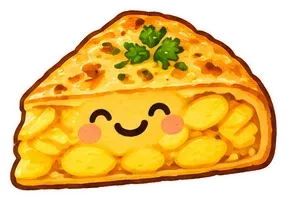
Spanish omelette looks like a cake and is made from two things most children know: eggs and potatoes. It's one of the easiest foreign dishes to say yes to.
- Taste
- mild, salty
- Texture
- soft, juicy, creamy



Read aloud to your child
Spanish omelette is thick, round and yellow, made of eggs, potatoes and onions. It is soft and juicy inside and has a nice golden crust. In Spain people eat it both warm and cold, often as a piece on a slice of bread. It looks like a little cake. Can you see the potato slices inside?
Egg and potato. If your child eats both, they already know everything in a Spanish omelette, sometimes with onion as well. There’s no spice to worry about, no sauce, nothing poking out.
What’s new is how it’s put together.
A tortilla that isn’t a wrap
In Spain it’s called a tortilla. That can confuse a child who knows the word from taco night, where a tortilla is a thin, soft flatbread. The Spanish one has nothing to do with it. It’s thick, yellow and round like a cake.
The potatoes are sliced thin and cooked slowly in olive oil until completely soft. Then they’re mixed with beaten egg and cooked in a pan until set. Inside, it’s soft and moist, almost creamy. Outside, it’s golden.
Cut a wedge and your child can see the slices of potato lying in layers, like a cake.

Onion or no onion
Whether it should have onion is a long-running argument in Spain. Some say a tortilla without onion isn’t a tortilla. Others say onion ruins it. Both sides are equally certain.
For a child who doesn’t like onion, that’s useful to know. Plenty of Spaniards agree with them. Make it without the first time. Onion can come later, and then your child can decide which side they’re on.
The flip
The most exciting part of making a Spanish omelette is turning it over. Once one side is cooked, you put a plate over the pan, flip the lot so the omelette lands on the plate, and slide it back into the pan uncooked side down.
That’s a grown-up’s job, and it doesn’t always work. But your child can watch, and that’s drama enough. If it goes wrong, you get a slightly broken omelette that tastes just the same.
Hot, warm and cold
In Spain, tortilla turns up all day. A small slice with a mid-morning coffee, part of lunch, or tucked into a baguette. It’s eaten hot, warm and cold, and plenty of people think it’s better the next day.
For children, that means more than one way in. Some like it warm and soft. Others prefer it cold, because it’s firmer and easier to hold. A cold wedge in a lunchbox is a new way to meet something old.
When it’s a no
Some children refuse mixed food even when they like the parts. They want egg and potato separately, not together. That’s very common. Pick a slice of potato and a bit of egg out of the wedge and put them side by side. Then your child can taste that it’s the same things, just joined up.
The guide to when they say no has more on letting a no stay a no without it being the end of the matter.
From Spain to your kitchen
If your child tried paella on holiday, a Spanish omelette is a natural next step from the Spanish kitchen, and it’s easier to make at home. In Food World in Mumse it sits under Europe. Next time you cut a wedge, your child can count the potato slices inside.
 Omelette
 Potato hash
 Paella
 Scrambled eggs
 Shakshuka
 Empanada