Omelette
An omelette is really an envelope. The outside is mild, yellow and familiar. Inside there might be something your child hasn't tasted yet.
- Taste
- mild, salty
- Texture
- soft, juicy



Read aloud to your child
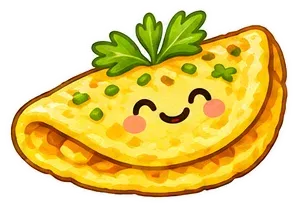
An omelette is eggs whisked and cooked in a pan like a thin, soft pancake. It is folded into a little half-moon, often with cheese or ham inside. It tastes mild and is easy to cut into pieces. The omelette comes from France originally. Can you see how evenly yellow it is?
What’s inside?
Cook an omelette, put the filling on one half and fold it over. Now the filling has vanished. That’s where the game starts.
“Guess what’s inside.” Your child can sniff, feel it, or press gently with a fork. Then you open it. Cheese runs. Ham shows up as pink pieces, pepper as red ones. The secret is small and mild, and it makes the omelette interesting without anyone having to say “taste it”.
The important bit: your child gets to know what’s inside before tasting. Being tricked isn’t a tasting.

Your child picks the filling
An omelette is one of the few meals where a child can decide almost everything. Put out a few small bowls:
- grated cheese
- strips of ham
- diced red pepper
- pieces of boiled potato
- something green, like spinach or chives
Your child picks two. Or one familiar and one new. It’s easier to taste something new when you chose it, and easier to choose it when the familiar thing is in the same omelette.
Thin and soft
An omelette should be soft and moist, yellow without brown patches. That takes medium heat and a bit of patience. Pour whisked eggs into a buttered pan. Let them set a little underneath. Lift the edge with a spatula and tilt the pan so the raw egg runs under. Repeat. While the top is still a little glossy, add the filling and fold.
It’s worth letting your child watch. The egg goes from runny to set in about half a minute.
In a tray
An oven omelette is another way. Eggs and milk are whisked together and poured over a filling in a dish or tray, then baked until set. It’s thicker and firmer than one from a pan, almost like a mild bake. Cut it into squares to eat with fingers, or take it on an outing.
For children who like to see what they’re eating, the oven version is more honest. The filling is visible in every piece.
Rolled in Japan
In Japan there’s an omelette called tamagoyaki, made by cooking thin layers of egg in a rectangular pan and rolling them up, layer on layer. It’s cut into thick slices with a spiral in each one, and it’s often slightly sweet.
You don’t need a special pan. A thin omelette rolled up and sliced shows the same spiral. It’s fun to look at and makes a familiar food new.
The word
The word omelette is French. In France, a classic omelette should be pale yellow outside and almost creamy within. Useful to know if you’re wondering whether yours is “right”. It doesn’t need to be brown.
Next door
The omelette sits between scrambled eggs and a proper dinner. Same eggs, just with a shape and a filling. Its next neighbour is the Spanish omelette, thick with potato and often onion, and good warm or cold.
In Mumse, a bite of omelette earns a star. If your child picked a new filling, that can be a new tasting of something else as well.
 Scrambled eggs
 Spanish omelette
 Egg
 Ham
 Mushroom
 Shakshuka