Egg
An egg can become a dozen different dishes. That is how a child can say yes to scrambled egg and no to a boiled one at the same breakfast.
- Taste
- mild, salty
- Texture
- soft, smooth, creamy, dry




Read aloud to your child
An egg is a smooth, oval shell that a hen has laid. Inside there is a yellow yolk and a clear white. The shell is hard and cracks easily when you tap it gently. Eggs can be boiled, fried or scrambled, and are used in cakes and pancakes. Did you know a hen can lay nearly one egg a day?
Same egg, different food
An egg can be scrambled, fried, boiled soft or hard, poached, made into an omelette, or disappear into pancakes and cakes. To an adult it is one ingredient. To a child it is a whole set of foods that look, smell and feel different.
So “I don’t like eggs” usually only applies to one of them.
Two halves that don’t agree
Inside an egg there are two things, and they behave almost like opposites.
The white is clear and slimy when raw. Heat turns it white and firm. In a hard-boiled egg it is smooth and a bit rubbery, almost bouncy when pressed. In a fried egg it may have a crisp brown lace round the edge.
The yolk is yellow and soft. Soft-boiled, it runs. Hard-boiled, it goes dry and crumbly and sticks to the roof of the mouth. Lots of children who dislike boiled eggs are fine with the white and can’t stand the yolk, or the other way round.
Cut a boiled egg in half and let your child separate the parts. Eat the white. Sniff the yolk. That is two tastes, and your child picks the order.
The smell
Boiled eggs smell, and for some children that is the end of it. The smell comes from sulphur in the white when it cooks for a long time. Boil an egg much past ten minutes and you may get a grey-green ring round the yolk, and more smell. Take it out earlier, cool it in cold water, and the smell fades.
Let them crack it
An egg is one of the first things a child can cook with. Tap it on the side of the bowl, pull it apart with both thumbs, and watch what slides out. Bits of shell often end up in the bowl. Scoop them out with a larger piece of shell; it works better than a spoon.
Scrambled egg is a good start. Your child cracks, whisks with a fork and watches the gloop turn into yellow curds in the pan. A child who has seen that change is often curious about the taste.
The Sunday egg
Many Norwegian families have a boiled egg for breakfast on Sundays, in an egg cup with a knitted cosy and a small spoon. It is a ritual of its own. Your child can be in charge of the egg timer, or of tapping the top off. It is easier to taste something you have helped with.
Egg on bread is common in Norway too, often with a squeeze of cod roe spread from a tube on top. It is a classic pairing, and many Norwegian children taste the roe spread only because the egg is there.
The shell tells you nothing
Brown and white eggs taste the same. The colour comes from the breed of hen, not from what is inside. The same goes for the yolk, which gets its colour from what the hen has eaten. A deep yellow yolk is not better than a pale one.
A small experiment: put a raw egg and a boiled egg on the table and spin them. The boiled one spins fast and smoothly. The raw one wobbles. Your child can guess which is which before you crack them.
Where next
Eggs go into lots of things. An omelette with cheese is a small step, and a fried egg on top of Scandinavian potato hash is a classic. Many tastes of different kinds of egg all count, even if your child only likes one. More on that in how many times.
Eggs are on the eggs, milk and cheese shelf in Mumse. Your child earns a star for every taste, boiled or fried. About Mumse.
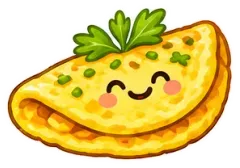 Omelette
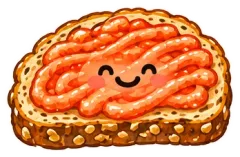 Bread with cod roe spread
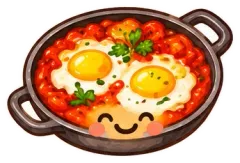 Shakshuka
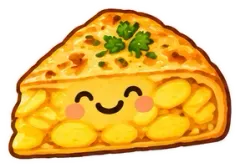 Spanish omelette
 Cress