Potato hash
Pyttipanne is small pieces of whatever was left over, fried together in a pan. The name is Swedish and means more or less that: little bits in the pan.
- Taste
- mild, salty, savoury
- Texture
- crunchy, soft



Read aloud to your child
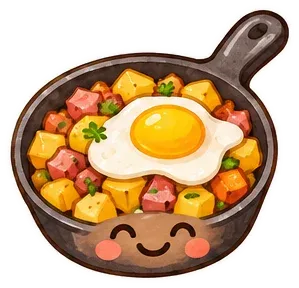
Potato hash is little cubes of potato, onion and meat fried together in a pan. It turns golden, a little crispy on the outside and soft inside. Many people put a fried egg on top so the yellow yolk can flow out. The Swedish name means something like «a bit of everything». How many little cubes can you fit on one fork?
Pyttipanne starts with a fridge full of leftovers. Yesterday’s potatoes. A bit of meat or a couple of sausages. An onion. Everything is diced small and fried together until golden.
The name is Swedish, pytt i panna, and means roughly little bits in the pan. That is exactly what it is. It is eaten all over Scandinavia, and Norwegian supermarkets sell it frozen in bags. If you know corned beef hash or bubble and squeak, you know the idea.
Small cubes
The nice thing about pyttipanne for a child is that everything comes in small, even cubes. Potato, meat, onion, maybe sausage. Each cube is its own bite, and it is easy to get on a fork.
The potatoes are crisp outside and soft inside. The meat is salty and a little chewy. The onion is sweet and soft. The taste is mild and salty, with the browned flavour of the pan.

Sort the cubes
Give your child some pyttipanne and ask: which cubes are potato? Which are meat? Can you find a bit of onion?
Your child can sort. Potato in one pile, meat in another. It may look messy, but they are seeing what is there.
Many children eat the potato first, as the most familiar. Then perhaps the sausage, if there is any. Then the meat.
How many on one fork?
A small game: how many cubes can your child fit on their fork? Three? Five? If they are different cubes, they taste several things in one bite.
The fried egg
Pyttipanne usually comes with a fried egg on top. The yolk can run over the cubes, and for many adults that is the best bit.
For some children it is the worst. A yellow yolk spreading over the food makes it wet and unfamiliar.
Put the egg beside it instead. Your child can taste the hash on its own. Perhaps a bit of egg separately. Perhaps dip a potato cube in the yolk. Their call.
Beetroot and gherkins
Next to pyttipanne there are often pickled beetroot or gherkins. Both are sharp and fresh, a good contrast to the salty fried hash. The beetroot turns everything pink, which can be reason enough to taste. The gherkin crunches.
Bought or home-made
The frozen bags have cubes all the same size. Home-made is more uneven, bigger and smaller pieces. Both are pyttipanne.
Yesterday’s dinner
Pyttipanne is an old way of using up leftovers, and that is worth telling a child: yesterday’s food can become today’s new food. If they had potatoes and meat for dinner yesterday, that is what is in the pan today. Just cut smaller.
Make it together
Pyttipanne is a good dish to make with a slightly older child. Cold boiled potatoes are soft enough to cut with a butter knife, and your child can do the dicing. The cubes will be uneven, which only means some get crispier than others. They can also choose what goes in: just potato and sausage, or potato, meat and onion.
A hash your child has chopped themselves is rarely left untouched.
Stewed and fried
Pyttipanne is close to lapskaus, also meat and potato, but stewed together in broth. The fried egg is a bridge to other dishes with egg.
Potato hash is among the dinners in Food World in Mumse. One potato cube earns a star. About Mumse.
 Spanish omelette
 Pickled beetroot
 Meat and potato stew
 Bacon
 Nasi goreng
 Sausage and mash