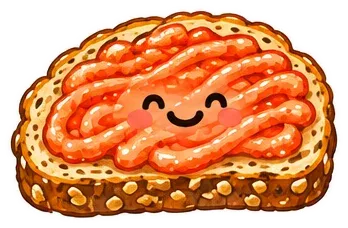
Bread with cod roe spread
In Norway, kaviar means a pink spread squeezed from a tube, not black pearls in a tiny tin. It is salty, sweet and smoky at once, and it is made from fish eggs.
- Taste
- salty, sweet, smoky
- Texture
- creamy, grainy





Read aloud to your child
Cod roe spread comes in a tube and is a pink-orange cream that you spread on bread. It is made from the eggs of cod, a fish from the sea, and tastes mild and a little salty. Many people put a slice of boiled egg on top. See how prettily pink it is. It is a typical Norwegian spread.
The tube lives in the fridge door. Your child has seen it a hundred times. They may have squeezed it, watched the pink stripe come out, and been told to stop.
That is a good place to start.
The tube is the way in
Give your child the tube and a slice of bread and let them draw. A line. A circle. A face. Kaviar is made to be squeezed, and it is hard to squeeze neatly. There will be blobs. Doesn’t matter.
When the drawing is done, it is their slice. They can taste one eye or a bit of the mouth. The rest can stay where it is.

The taste
It is salty. It is also sweet, because there is sugar in it, and smoky, because the roe is smoked. Three strong tastes, all arriving at once.
The texture is creamy but grainy. The tiny grains are the fish eggs. They don’t pop, but your child can feel them on the tongue if they look for them.
A little goes a long way. A thin line across a whole slice tastes of more than you would think.
Fish eggs
The spread is made from cod roe: thousands of tiny eggs that the cod would have laid in the sea. The roe is smoked, mixed with sugar, salt and oil, and squeezed into tubes.
It is fine to tell your child. Some find it exciting. Some find it gross. Both are fine reactions, and neither makes tasting any harder.
The caviar in films, black and glossy in small tins, is sturgeon roe. It is expensive and tastes of something else entirely. In Norway kaviar nearly always means the pink one in a tube, and Swedes have their own famous version too.
With egg
The most common Norwegian kaviar sandwich has a sliced boiled egg underneath. The egg is mild and soft, the roe salty and strong, and together they balance.
For a child who likes egg, this is a natural route. Lay the egg slices on first, and a very small dot of kaviar on each. Your child can take the egg on its own, or with.
Why a tube?
Norwegian kaviar has come in tubes for decades. The tube keeps the air out and makes a thin line easy. To a child it is also something to work on: it has to be rolled up from the bottom like toothpaste. That is a job children happily take on.
On crispbread
Kaviar on crispbread is common too. The crispbread is dry and plain and takes the edge off the salt. Plenty of people prefer it that way to soft bread.
When it is too strong
Kaviar is one of those foods children often refuse for quite a while. The taste is strong, and nobody needs to hurry. The tube can stay on the table. Your child can squeeze a line onto someone else’s bread, or smell the tube. More on this in when they say no.
Other fish on bread
Kaviar has a relative in mackerel in tomato sauce, another fish on bread, milder and without the smoke. And salmon is another fish whose colour children notice.
Bread with cod roe spread is on the breakfast shelf in Mumse. A dot from the tube earns a star. About Mumse.
 Egg
 Bread with mackerel in tomato sauce
 Mayonnaise
 Crispbread
 Tuna
 Smørrebrød