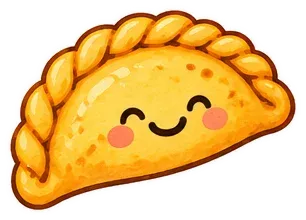
Empanada
An empanada is just the right size for one small hand. The edge is folded into little pleats, and in Argentina those pleats can tell you what's inside.
- Taste
- mild, salty
- Texture
- crunchy, soft, juicy



Read aloud to your child
An empanada is a little half-moon pie filled with meat, cheese or vegetables. The dough is golden and crispy, and the edge is folded in tiny pleats. It comes from Spain and South America. It is just the right size to hold in your hand. Can you find the pretty folds?
Empanada comes from the Spanish for wrapping in bread. That’s exactly what it is: a round of dough, filling on one half, folded into a half-moon and sealed at the edge. Then it’s baked or fried until golden.
They’re found in Spain, where they started, and all over Latin America, where every country and nearly every region has its own. Argentina, Chile, Colombia and many others have strong views on how an empanada should be.
The edge tells you
In Argentina the edge is often folded into small, tight pleats, like a plait. It’s called the repulgue. And in some places different patterns are used for different fillings, so you can tell from the edge whether there’s beef, chicken or cheese inside. A bakery might use one pattern for beef and another for cheese, and customers know what to look for.
That’s an idea worth borrowing. At home you can make your own system. Fork marks on the edge mean cheese. A plaited edge means meat. A small hole on top means chicken. Your child can read the edge before choosing.

The filling
The classic Argentine empanada is filled with beef, onion, spices and often chopped egg and olives. That can be a lot for a child. Cheese is milder, and ham and cheese is a common version many children like.
Cut an empanada in half before your child tastes. The steam escapes, and they can see the filling. It’s much hotter than the pastry, so wait a little. If the filling looks like something your child knows, like minced meat or melted cheese, taking a bite is easier.
Pastry first
Plenty of children eat the edge first. It’s the thickest and crispest part and tastes like a biscuit. Let your child eat inwards from the edge at their own pace. By the time they reach the filling, they’ve already tasted the empanada.
Some children only want the edge. The edge counts too, and next time they might get a little further in.
Make them together
Empanadas are good to make with children. Buy ready-made shortcrust or puff pastry. Cut out circles with a glass or cup. Your child puts a spoonful of filling on one half, wets the edge with water, folds it over and presses the edge with a fork. Brush with egg and bake.
Let your child make some with just cheese and some with something new. A spoonful of sweetcorn, a little pepper, or chicken. Use the edge system, so they know which is which after baking.
Folding dough round a filling is an idea almost every country has had. Dumplings from China and pierogi from Poland are close relatives. If your child has made empanadas, they might enjoy knowing that children in China fold dumplings in much the same way.
Folded by hand
An empanada your child folded can have its photo taken with the toy camera in Mumse before it gets eaten. Make sure the edge is in the picture.
 Dumplings
 Pide
 Taco pie
 Spring rolls
 Quesadilla
 Lahmacun