Spring rolls
A spring roll makes a noise. The crisp shell cracks loudly, and that's often enough for a child to take another bite just to hear it again.
- Taste
- mild, salty, sweet
- Texture
- crunchy, soft, juicy



Read aloud to your child
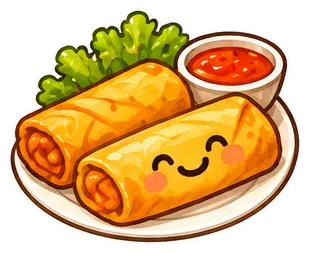
Spring rolls are crispy, golden rolls filled with vegetables and sometimes chicken. They come from China and other parts of Asia. The outside is thin and crunchy, and the inside is soft and warm. They crackle loudly when you bite, so listen closely.
Hold a spring roll up to your ear and bite. The crunch arrives before the taste, and it’s loud. The wrapper is paper-thin and fried golden, and it breaks into small flakes that scatter over the plate.
For lots of children that’s an easy way in. The sound is fun, and crunchy is a texture many already like. The tricky bit is what’s inside.
The name
In Chinese, spring rolls are chun juan, which means exactly that. The name comes from the Spring Festival, the Chinese name for the New Year, where the rolls have traditionally been part of the celebration food. Their colour and shape are often compared to little gold bars, standing for wealth and luck in the year ahead.
That’s a nice thing to mention while you eat. Your child is holding a small gold bar.
Peek inside
Cut a spring roll across, or bite off one end and look. Inside there’s shredded cabbage, carrot, onion and often bean sprouts. Some have glass noodles, clear and slippery. Some have chicken, pork or prawns.
The filling is soft, hot and juicy, the opposite of the shell. It tastes mildly of vegetables, a little salty and a little sweet. A child who won’t touch cabbage on a plate may well eat it in a spring roll without thinking, because the crunch comes first.
That’s not a trick to hide it. Tell them what’s in there. A child who knows they ate cabbage and thought it was fine has learned something about themselves.
Hot in the middle
Spring rolls come straight out of the fryer, and the filling holds its heat much longer than the wrapper. The outside can feel lukewarm while the middle is still very hot. Break the roll in half and let it steam for a bit before your child bites.
To dip or not
Spring rolls often come with sweet chilli sauce, red and glossy. It’s mostly sweet, but there’s some chilli and some children notice it. A dish of soy sauce is saltier and gentler on heat. Many children prefer the roll plain.
Let your child dip for themselves from a small bowl on the side. Then they decide how much, and an overly hot dip is their own doing, not yours. That makes it easier to try again.
From the freezer
Frozen spring rolls are sold in plenty of supermarkets and crisp up in the oven. That makes them easy for an ordinary weekday, next to a stir-fry or as something to pick at. A frozen one isn’t the same as a fresh one from a restaurant, but the crunch is there.
If you fancy making your own, thin spring roll wrappers are sold in Asian shops. Your child can put filling on a sheet, fold in the sides and roll, a bit like wrapping a present. A grown-up does the frying.
The relatives
Spring rolls have lots of relatives. Dumplings are filling wrapped in dough and boiled or steamed, softer and smoother. Vietnamese summer rolls are rice paper round fresh vegetables and noodles, neither fried nor crisp. Let your child compare: which makes the most noise, which is softest?
Listen first
Spring rolls are under Asia in Food World in Mumse. Next time they’re on the table, ask your child to listen for the crunch on the first bite. It’s a tasting that starts with the ears.
 Dumplings
 Sweet and sour chicken
 Noodles
 Soy sauce
 Empanada
 Pad thai