Dumplings
Children wary of new food rarely like food where they can't see what's inside. Dumplings are exactly that. But they can also be opened.
- Taste
- mild, salty, savoury
- Texture
- smooth, soft, juicy


Read aloud to your child
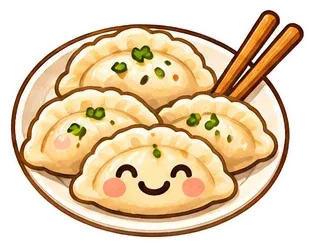
Dumplings are small, soft pockets of dough with filling inside. They come from China, but you can find them in many countries. The dough is smooth and a little chewy, and inside there is a juicy filling, like meat and vegetables. They are steamed or pan-fried, and often eaten with chopsticks. Try one.
A dumpling is a small parcel. The outside is smooth, glossy and slightly see-through. You can make out something darker inside, but not quite what. For a child who wants to see food before tasting it, that can be enough for a no.
But a parcel can be opened. That’s where it starts.
A parcel to unwrap
Split a dumpling in two with a chopstick or fork. Steam comes out. The filling is usually meat or prawns, finely chopped with cabbage, spring onion and ginger, and it’s juicy and fairly mild. The wrapper is soft and a little chewy, and if the dumpling was fried, the base is brown and crisp.
Look at the filling together. What do you think is in there? Green bits? Meat? A child who has seen inside knows what to expect. Maybe they’ll only taste the wrapper this time, which tastes rather like boiled pasta.
Watch the heat. The filling stays hot far longer than the wrapper, and it’s easy to get burnt. Wait until the steam stops. Some dumplings, like xiaolongbao from Shanghai, hold hot soup inside and should be eaten carefully from a spoon.

Dumplings everywhere
Dough around a filling turns up almost everywhere. In China they’re jiaozi, eaten at Chinese New Year and often folded to look like old gold ingots, for luck. In Japan they’re gyoza, usually fried crisp on one side. Korea has mandu, Nepal and Tibet have momo, Poland has pierogi and Russia has pelmeni. In Latin America the empanada follows the same idea, usually baked or fried.
That’s a nice thing to tell a child. Nearly every country has thought of wrapping something good in dough.
Fold your own
Dumplings are one of the best dishes to make with children. In many countries it’s something families do together round a table, chatting while they fold.
Buy ready-made dumpling wrappers, which you’ll find at Asian grocers and in the freezer section of many supermarkets. Make a simple filling of minced pork or chicken, grated carrot and a splash of soy sauce. Your child puts a teaspoon of filling in the middle, wets the edge with water and pinches it into a half-moon. Little pleats along the edge look lovely, but a plain half-moon works too.
Your child’s dumplings won’t match. Some split, some are overstuffed. It doesn’t matter. Once they’ve been steamed or fried, they’re your child’s own dumplings, and most children want to know how they taste.
The dip
Dumplings usually come with a small dish of soy sauce, vinegar or chilli oil. Give your child soy sauce. It’s salty and familiar from sushi and noodles, and a little dip can make the wrapper more interesting. The chilli oil can wait.
Chopsticks or fingers
Dumplings are slippery and hard to hold with chopsticks, which makes them fun to practise on. But a fork or fingers are just as good, and for small children it can be easiest to spear them.
A photo before the first bite
If you folded your own, your child can photograph them with the toy camera in Mumse before tasting. A dumpling split in half where only the wrapper got tasted earns just as much of a star as a whole one.
 Spring rolls
 Soy sauce
 Empanada
 Miso soup
 Ramen
 Udon