Stir-fry
A stir-fry is the opposite of a stew left to simmer. Everything happens quickly, the pan hisses, and the vegetables are still crunchy when they reach the plate.
- Taste
- salty, savoury, sweet
- Texture
- crunchy, juicy, chewy


Read aloud to your child
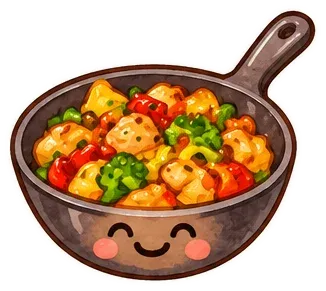
Stir-fry is a dish cooked in a big, round pan called a wok. It comes from China. Vegetables and meat or tofu are fried very quickly over high heat, so they stay crisp and fresh. The food can be full of colour and smells strong. Can you hear the sizzle when the ingredients jump in the pan?
Before your child sees anything, they’ll hear it. Vegetables hitting a hot wok make a loud hiss, a bit like rain on a roof. It’s a good start: something is already happening, and nobody has asked them to eat a thing.
In Norway, people often just call this dish wok, after the pan. The pan itself comes from China and is wide and round at the bottom. The food is whatever gets cooked in it: vegetables, chicken, meat or tofu, cut small and fried over very high heat for a few minutes, then a sauce, often with soy, and rice or noodles alongside.
Crunchy, not limp
Plenty of children who won’t touch boiled vegetables happily eat them raw. Boiled broccoli is soft and smells stronger. Raw broccoli crunches.
A stir-fry sits somewhere in between. The vegetables are hot, but they haven’t had time to go soft. A piece of pepper from the wok still has some bite and tastes sweeter than raw. Mangetout are crisp and shiny. Carrot in thin strips is mild and sweet.
That makes a stir-fry a good route for a child who likes raw vegetables but refuses anything that has seen a saucepan.

Pick a vegetable
Because everything is chopped before it’s cooked, it’s easy to bring your child in. Lay the vegetables out on the chopping board first and let them choose one to go in. Maybe red pepper, maybe baby corn, maybe something they’ve never tried.
A child who has chosen and cut a vegetable has already touched it, smelled it and seen what it looks like inside. That’s a lot of contact before anyone takes a bite.
Taste it raw on the board, then again after it’s been in the wok. They’re two quite different tastes, and your child can decide which they prefer.
When everything gets mixed
The tricky part is that everything ends up in one pan. The sauce coats it all, and your child can no longer see what’s what. For a child who likes food kept separate, that’s a wall.
It’s easy to get round. Lift your child’s vegetables and meat out before the sauce goes in, put them in little piles on the plate, and serve the sauce in a small bowl. It’s still a stir-fry.
The sauce
Soy sauce is salty and full of umami, that deep, savoury taste. Many stir-fries also have ginger, garlic or chilli. Ready-made stir-fry sauces can be sweet and sometimes fairly hot, so check before your child tries one.
A single drop of soy on a clean spoonful of rice is a decent first taste. It’s salty, but it’s only a drop.
Chopsticks help
Chopsticks change a stir-fry. Picking up one pea with two sticks takes concentration, and every bite becomes a small task. Training chopsticks joined at the top are easy for small hands to pinch. Your child looks closely at the food to catch it, and tastes one piece at a time. There are more ideas like this in the guide to tasting games.
In Mumse, your child can photograph the vegetable they chose and earn a star for tasting it. Next week it can be a different one.
 Noodles
 Pad thai
 Nasi goreng
 Soy sauce
 Broccoli
 Sweet and sour chicken




