Fårikål
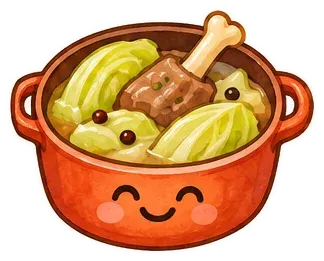
Fårikål is mutton or lamb, white cabbage, whole pepper and salt, simmered for a couple of hours in one pot. Four ingredients, and still enough to make a child stop and look.
- Taste
- mild, salty
- Texture
- soft, juicy, stringy




Read aloud to your child
Fårikål is Norway's national dish. Pieces of lamb and white cabbage are layered in a big pot and simmer slowly together with a little pepper. It turns soft, warm and mild, and it smells cosy like home. People like to eat it in autumn with potatoes. Can you spot the black peppercorns in the pot?
Every autumn, when the lambs come down from the hills, Norwegian kitchens fill with the smell of fårikål. The name means something like “sheep in cabbage”, and that’s very nearly the whole recipe. Pieces of lamb or mutton on the bone are layered in a big pot with wedges of white cabbage, whole black peppercorns are scattered between the layers, salt and water go in, and the lid goes on for a couple of hours. Boiled potatoes come on the side.
It has been voted Norway’s national dish twice. Listeners to the radio programme Nitimen chose it in 1972, and in 2014 a survey for the Ministry of Agriculture and Food gave it the title again. Both times the runner-up was meat patties. Since the late 1990s, the last Thursday in September has been Fårikål Day.
Few ingredients, plenty of strangeness
For an adult, fårikål is simple. For a child, it can be a lot. The cabbage is huge and floppy. The meat has bone, fat and the odd bit of membrane. And everywhere there are little black balls.
None of that is a reason to skip it. It’s a reason to take it in parts.

The peppercorns
This is where most of the trouble starts. A whole peppercorn is hard, and biting into one is a shock of heat. A child who has done it once will remember.
So show your child the peppercorns before you start. Pick one out and put it at the edge of the plate. Explain that they’re there to flavour the pot, not to be eaten. Plenty of children enjoy the job of hunting them down. It also means they look closely at the food, which is half the work.
Start with the cabbage
The cabbage is the surprise. Raw white cabbage is crunchy and a little sharp. After a couple of hours in the pot it has turned glossy, soft and almost sweet, soaked in the lamb and the pepper. A lot of adults go back for more cabbage than meat.
Offer a small piece from the pale heart of the wedge. It’s the softest part. The outer leaves are longer and more stringy.
Then the lamb
Lamb has more flavour than chicken or pork, with a rich, slightly sweet taste that some children take to at once and others need time with. The fat is noticeable, so trim it from your child’s piece.
Take the meat off the bone first. After that long a simmer, it more or less falls off. A shred of lamb, a spoonful of broth and a piece of potato is a good first mouthful. The potato is familiar, and it soaks up the broth until it tastes of fårikål.
Only in autumn
Fårikål is mostly an autumn dish, so it may only appear a few times a year. That’s a long gap for a small child’s memory, and it may take several autumns before it feels familiar. Say so out loud: we only eat this in autumn, and it’s fine just to look at it this time. The guide on when they say no has more on that.
If your child likes lapskaus or Norwegian beef soup, fårikål isn’t far away. It’s the same idea: meat and vegetables that have cooked slowly together until everything is soft.
The last Thursday in September could be a good evening to bring out Mumse. One piece of cabbage earns a star, whatever your child thinks of it.
 Meat and potato stew
 Norwegian beef soup
 Flatbread
 Meat patties
 Sauerkraut
 Lingonberry