Meat patties
Kjøttkaker are Norway's answer to the meatball: bigger, flatter and usually swimming in brown gravy. The patties themselves are rarely the problem. The gravy is.
- Taste
- mild, salty, savoury
- Texture
- soft, juicy




Read aloud to your child
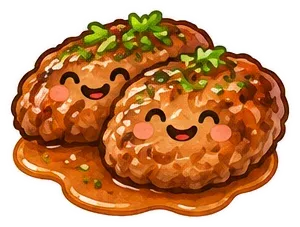
Meat patties are soft, round cakes made from minced meat, fried in a pan until they are golden brown outside. In Norway they are a classic dinner, served with potatoes, gravy and vegetables. Feel how juicy they are inside. They look a bit like small, flat buns. Many people say they smell just like grandma's kitchen.
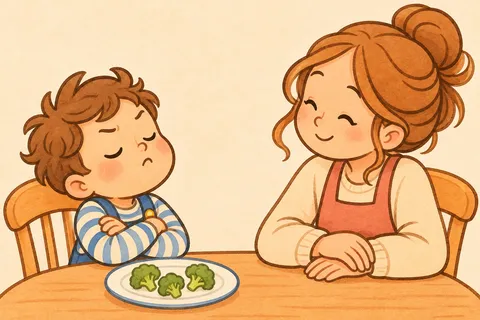
You can smell kjøttkaker from the stairwell. Brown gravy, fried onion, maybe cabbage. For a lot of Norwegian adults it is the smell of a grandmother’s kitchen. For a four-year-old it can be the smell of a plate where everything is brown and nothing can be told apart.
What they are
Kjøttkaker translates as meat cakes, and the recipe is plain: minced beef, salt, pepper, often a little nutmeg and ginger, milk and potato starch or breadcrumbs, shaped by hand and fried. They are larger and flatter than a Swedish meatball, roughly the size of a child’s palm. Inside they are soft and juicy. Outside they have a brown crust where they met the pan. The taste is mild and savoury.
Then comes the gravy. Norwegian brown sauce is made from the pan juices, flour and stock, and it is poured over the patties, the boiled potatoes and anything else nearby. This is where many children stop. They cannot see what is underneath, and the gravy tastes stronger than the meat.

Take the gravy off
Serve one patty with no gravy at all. Cut it in half so your child can see inside: greyish-brown, a little steam rising. A patty without its sauce looks a lot like a small burger, and children who have refused kjøttkaker for a year will sometimes take a bite of that.
The gravy can sit in its own bowl. Your child can dip, sniff, or ignore it. It still counts that it was there.
Small hands, small patties
Raw patty mixture is cold, sticky and slightly disgusting, which makes it one of the best things a child can get their hands into. Wet their hands so it doesn’t cling, and let them shape their own. They will be lopsided, which is the whole charm.
Nobody tastes the raw mixture, and hands get washed afterwards. But a child who has made their own patty nearly always wants to see how it turned out, and from there a bite is not far off. Small ones also cook through faster and stay moist. A patty the size of a walnut is one bite, not a project.
The rest of the plate
A traditional kjøttkaker dinner might include boiled potatoes, creamed peas or creamed cabbage, and lingonberries. That is a lot of new things at once. Pick one to try and let the rest simply be there. Lingonberries are often the easiest: bright red, tart and sweet, and plenty of children spoon them onto their patty unprompted. Creamed cabbage, pale and soft and smelling of cabbage, can wait.
No two the same
No two Norwegian families make kjøttkaker quite alike. Nutmeg or ginger, fried hard or left to simmer in the gravy until they are completely soft. It is why a child can love the ones at nursery and refuse them at home, or the other way round. Ask how the nursery makes theirs.
For a lot of children the turning point is being put in charge of the shape. The stars come out mostly as lumps, but they are theirs, and so they get tasted.
From here
Kjøttkaker lead naturally to anything else made from mince, from tacos to spaghetti sauce. And from patties in gravy it is not far to lapskaus, the stew where meat and vegetables cook down together.
Meat patties sit on the meat and poultry shelf in Mumse, with five star spaces that fill one taste at a time. More about the app.
 Gravy
 Meatballs
 Lingonberry
 Sauerkraut
 Fish cakes
 Peas