Meatballs
A meatball is small enough for one mouthful and round enough to roll off the plate. Kitchens all over the world have one, and it tastes a bit different nearly everywhere you go.
- Taste
- mild, salty, savoury
- Texture
- soft, juicy






Read aloud to your child
Meatballs are small, round balls of meat fried golden-brown. They are soft and juicy inside and taste mild and nice from herbs and spices. Lots of children love them with mashed potato and gravy. Can you roll a little meatball between your hands like a snowball?

A ball of meat, everywhere
Kitchens all over the world have some kind of ball made from minced meat. Fried or poached, large or small, with sauce or without. That makes the meatball one of the easiest bridges from familiar to new. Your child holds on to the round, known thing and tastes something different around it.
Around the table
It’s fun to know where the different meatballs come from.
- Sweden: small köttbullar with a creamy brown sauce, mashed potato and lingonberries. For Norwegian children, that’s almost home.
- Italy: polpette, often bigger, simmered in tomato sauce. In Italy they’re usually eaten on their own, not on top of spaghetti.
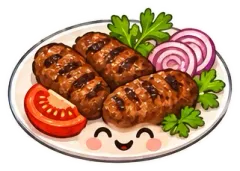
- Turkey and the Middle East: kofta, often shaped long rather than round, seasoned with spices like cumin and frequently grilled.
- The United States: spaghetti and meatballs, the famous plate of meatballs in tomato sauce on pasta.
Pick one and make it at home. Talk about the country while you eat. The meatball is the same ball, but the sauce and the spices take your child somewhere else.
Patty or ball
Norwegian meat patties, kjøttkaker, and meatballs are almost the same mixture. The difference is the shape and the sauce. Kjøttkaker are big and flat and sit in brown gravy. Meatballs are small and round and just as likely to sit in tomato sauce.
So a child who likes one already knows the taste of the other. What’s new is the shape and the sauce. And a child who refuses meat patties because of the gravy might happily eat a meatball sitting on its own.
The sauce can wait
With meatballs, the sauce nearly always goes on top, and that’s often where things stall. Tomato sauce is tangy. Cream sauce is rich. Gravy is strong. All of them cover the ball.
Set a few meatballs aside before they go into the sauce. Your child can taste a plain one first and dip the next. Or put the sauce in its own bowl. The sauce is a tasting of its own, and it can wait for another day.
Small hands, small balls
Meatballs are a good size to make together. Something the size of a dice is a handy guide. Your child rolls the mixture between their palms, and the wonky ones cook just as well as the neat ones. Wet hands with cold water so the mixture doesn’t stick.
Raw mixture isn’t for tasting, and hands get washed afterwards.
Plenty of children want to taste something they rolled themselves. Make a couple of extra small ones so your child has their own on the plate.
With spaghetti
Spaghetti bolognese and spaghetti with meatballs are close relatives. One has the mince crumbled into the sauce, the other has it rolled into balls. A child who eats one is often not far from the other. The balls are easier to see, and some children like to know exactly what’s what on the plate.
What’s inside
Cut a meatball in half together. Inside it’s greyish-brown and a little open-textured, with steam rising. If there’s onion in it, you’ll see small glossy pieces. Parsley shows up as green flecks. Your child can guess what’s in it before you look, and then have a sniff.
It’s an easy way to make a familiar ball a little bit new. It’s also a handy check for the grown-up: the middle shouldn’t be pink.
In Mumse meatballs are on the meat and poultry shelf, and a meatball in a new sauce can be a new tasting. It earns a star however it tasted.
 Spaghetti bolognese
 Kofta
 Lingonberry
 Gravy
 Fish balls