Green grapes
A green grape is cool, sweet and full of juice. Plenty of children take one without a second thought. Others feel the skin burst and the juice rush out, and decide that is too much at once.
- Taste
- sweet, tangy
- Texture
- juicy, smooth



Read aloud to your child
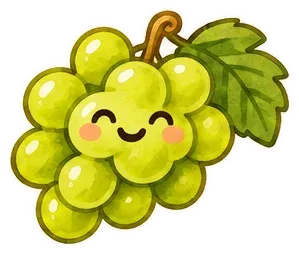
Green grapes grow in bunches on winding vines in sunny places. Each grape is small, round and light green, almost see-through in the sunshine. When you bite one, the skin pops and the juice runs out, sweet and fresh. Some have tiny seeds, others have none. Can you pick them off the bunch one by one?
Grapes look like the simplest food there is. No peel to remove, no stone to dig out, just pick and eat. For lots of children that is exactly how it goes. But some children have a very different relationship with grapes, and it mostly comes down to the skin.
Safety first, briefly
Whole grapes are just the size and shape to get stuck in a small child’s throat, so cut them lengthways into halves or quarters, and ask your health visitor what applies at your child’s age.
Conveniently, that is also a good start for tasting. Half a grape is less daunting than a whole one.
Skin and juice
A green grape has a smooth, taut skin and a jelly-like inside. Bite it and the skin pops and the juice comes in a single rush. Some children find that fun. Others find it too sudden, and are left with a chewy bit of skin that will not go away.
You can deal with this head on:
- Cut a grape and look inside. The pale green jelly, perhaps a pip.
- Lick the cut side first. The flavour arrives before the skin does.
- Feel the difference. Half a grape skin-side down and one skin-side up do not feel the same on the tongue.
- Peel one. It takes patience, but with large grapes it works. Some children happily taste a peeled grape first and get to the skin later.
A sour bunch or a sweet one
Grapes do not ripen further once picked. What they are when cut from the vine is what they stay. A bunch can therefore be tart the whole way through, so taste one yourself before your child does.
Green grapes are often fresher and sharper than red or black ones. Some children like exactly that. Others think green is sour and black is sweet. If you have more than one colour in the house, taste one of each.
Pips or no pips
Most grapes in the shops now are seedless, though some still have a soft little remnant of a pip. Other varieties have proper pips that taste bitter if you chew them. Mention it before your child tastes: “There might be a little pip inside. You can spit it out.” Then it is not a surprise.
Raisins are dried grapes. That is a nice thing to show a child who likes raisins but not grapes, or the other way round. Same fruit, two completely different things in the mouth.
Off the bunch
Grapes grow in bunches on climbing vines, and picking them off the stalk yourself makes them easier to take. Put a whole bunch on a plate, let your child pick, and cut them while they watch. Snip little clusters of two or three so they can hold them by the stalk.
Grapes are also at home in a fruit salad, where they become one familiar thing among others.
If your child is not having it
Some children are very sure of their position on grapes, and there is nothing wrong with that. Leave them on the table, eat them yourself, and let a few weeks go by. One day your child will take half a grape because everyone else is.
Green grapes are in Food World in Mumse. A taste earns a star even with a thumbs down, and Mumse says that it is all right not to like it.
 Cherry
 Gooseberry
 Blueberry
 Kiwi
 Watermelon