Cherry
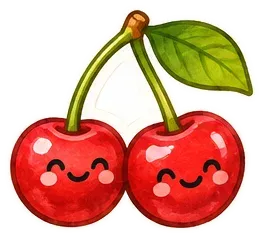
Cherries are small, shiny and red, and they hang in pairs on long stalks. Plenty of children are curious about them. What makes them tricky is the stone: something hard in the middle that needs watching.
- Taste
- sweet, tangy
- Texture
- juicy, smooth



Read aloud to your child
Cherries are small, round, shiny fruits with a long stem. They grow on cherry trees, which bloom with white or pink flowers in spring. Inside there is a hard stone that you have to spit out carefully. The taste is sweet and juicy, and the skin gives a little snap when you bite. Hang two cherries over your ears like earrings.
Some fruits are made for playing with, and cherries are one of them. Two on one stalk hang over an ear as earrings. The stone can be spat a long way, if you are outdoors. And the stalk can be tied in a knot with your tongue, by those who can manage it.
None of that is tasting. All of it is a way in.
What’s the deal with the stone?
In the middle of every cherry sits a hard, smooth stone. That’s what makes cherries a bit harder than other berries. Your child can’t just pop one in and chew. They have to bite carefully, find the stone with their tongue and spit it out. For an adult it is automatic. For a child, it’s a lot to manage while also tasting something new.
For the littlest ones the stone is also a hazard, because it can get stuck in the throat. Take the stone out and halve the cherry for small children; your health visitor can say when they are ready to manage it themselves.

Stoneless first
The easiest first step is to remove the problem. Halve the cherry, twist the halves apart and lift out the stone. What’s left is a small, dark, juicy half. Your child can hold it, look at the deep red inside and taste without worrying about biting something hard.
Once the taste is familiar, try a whole cherry together. Bite carefully around the stone, make it obvious, and show how to spit it into your hand.
Earrings and stone collections
- Earrings. Hang a pair over an ear and look in the mirror.
- A stone collection. Line up the stones left on the plate and count them. How many cherries got eaten?
- Stone spitting outside. Who can spit furthest? A summer game in lots of families, and it teaches your child to find the stone with their tongue.
- Cold from the fridge. Chilled cherries are firmer and feel fresher in the mouth.
- Sour cherries as jam. Cherry jam is sweet, smooth and stone-free. A different way to meet the same flavour.
Two words for one fruit
There are sweet cherries and sour ones. The sweet ones are the glossy cherries you eat from the bag, and many Norwegians call the dark, sweet ones moreller. The sour ones are sharper and mostly end up in cordial and jam.
Norway’s own sweet cherries come from Hardanger and Sogn, where the trees stand in rows along the fjords and blossom white in May. The fruit ripens in July, and then crates of dark, glossy cherries appear at roadside stalls and in the shops. They are often bigger and sweeter than the imported ones the rest of the year.
It’s nice to tell your child that the trees flower white in spring before the cherries come. If there is a cherry tree near you, your child can follow it from blossom to fruit.
No stone in this one
Cherries look so pretty that it is easy to get keen. Try not to. Leave a bowl of stoneless halves on the table, and let your child help with the stone collection or the earrings first.
If the stone is the worry, say it out loud: “There’s no stone in that one. I took it out.” Knowing that helps.
Half a stoneless cherry is still a taste. In Mumse it earns a star, and maybe a photo of your child wearing cherry earrings.
 Green grapes
 Blackberry
 Redcurrant
 Raspberry
 Cordial
 Red berry pudding with cream