Watermelon
A watermelon is so big a small child could nearly sit on it. Inside it is bright red, cold and mostly water, and it drips on everything.
- Taste
- sweet, mild
- Texture
- juicy, grainy



Read aloud to your child
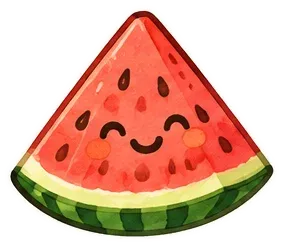
A watermelon is big and round with green striped skin. Inside it is bright red and so juicy that it is almost like water. It grows on the ground in warm countries. When you bite it, it drips. Look for the black seeds, and maybe you can spit them far. It is sweet, cool and perfect on a hot day.
A project before anyone tastes it
Watermelon is the only food most of us bring home that needs two hands and somewhere to put it down. That alone makes it interesting to a child. Before anyone has tasted a thing, it has already been a small project.

A yellow patch and a heavy lump
Watermelons grow on the ground, on a plant that creeps along like a snake. Where the melon has lain while ripening it gets a pale patch, and on a ripe one that patch is yellow or creamy. That is a good job for a child in the shop: find the yellow patch.
Feel how heavy it is, too. A ripe watermelon is heavy for its size because it is so full of water, more than nine tenths of it. Children like it when a name turns out to be true.
Inside
When the melon is cut, colour comes first. Bright red or pink, with dark seeds in rows, or just a few soft white ones. Then the smell, which is faint, fresh and a bit like cucumber. That is no coincidence: watermelon belongs to the same family as cucumber and pumpkins.
The texture is unusual. The flesh is crisp and grainy at once and turns to juice almost as soon as you bite. Some children love it. Others find it odd that food can vanish in the mouth.
Those seeds
Many children have heard that a watermelon will grow in their tummy if they swallow a seed. It will not, and it is worth saying so out loud before you start. The seeds are harmless. The white ones in seedless melons are empty seed coats that never finished growing.
Even so, seeds are often why children hesitate. It helps to make something of them:
- Pick them out together. With a fork or with fingers. A good job for a child not ready to taste yet.
- A spitting contest. Outside, on the grass or at the beach. Who can spit furthest? You cannot spit a seed without having melon in your mouth first.
- Go seedless. For a child who really will not, it is fine to start without.
Triangles, cubes and something like an ice lolly
Watermelon is easy to cut into shapes children recognise. Triangles with the rind on can be held like a slice of pizza. Cubes can go on a fork. A melon ball scooped with a spoon is round and neat. And slices frozen for a few hours become something close to an ice lolly, with nothing in it but melon.
The rind can be part of it too. Green stripy outside, white beneath, then red. Touch all three. The white part is edible but tastes of almost nothing, which is its own small discovery.
A summer food
Watermelon belongs to summer. It tastes of sunshine and warm pavements, and it makes a mess. That is why it suits being eaten outside: on a trip, in the garden, in the park, at the beach. Nobody minds the drips when there is grass underneath.
A child who says no to watermelon at the kitchen table in February may well say yes in July.
You can put watermelon on the shelf in Mumse. Your child taps to say they tasted it, picks a thumb and gets a star, and after five different days the watermelon becomes gold food.
 Green grapes
 Fruit salad
 Ice lolly
 Pineapple
 Kiwi
 Water