Gooseberry
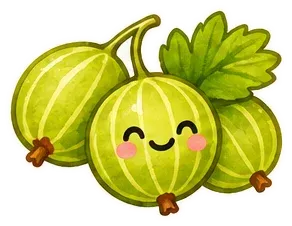
Gooseberries look like little paper lanterns with stripes. They can be green, yellow or red, and they can taste sour enough to make you shudder, or surprisingly sweet.
- Taste
- tangy, sweet
- Texture
- juicy, smooth, chewy





Read aloud to your child
Gooseberries are round, slightly see-through berries with thin stripes on the skin, almost like tiny lanterns. They can be green, yellow or pink, and grow on thorny bushes in the garden. The taste is tart and fresh, and sweeter when they are very ripe. Some feel a little hairy on the outside, so check. Hold a berry up to the light and look at the stripes.
A lantern you can eat
Hold a gooseberry up to the light. It is almost see-through, with thin stripes running from top to bottom and the shadow of seeds in the middle. It looks like a paper lantern. That is worth doing before anyone tastes, because it is so unlike other berries.

Thorns, colours and hairs
Gooseberries grow on thorny bushes, and the Norwegian name, stikkelsbær, most likely comes from those prickles. They ripen in July and August, at the same time as redcurrants and blackcurrants, to which they are related. Many Norwegian gardens have an old bush tucked into a corner, often one nobody quite remembers planting.
The berries come in several colours: green, yellow and red, with some reds that are nearly purple. Some have smooth skins, others are covered in tiny hairs. For a child who is sensitive to how things feel, the hairs can be enough for a no.
Three layers
Three things happen when you bite a gooseberry. First the firm skin pushes back. Then it gives with a small pop. Then comes the jelly-like middle full of seeds, smooth and juicy.
Many children are fine with the skin but find the middle strange. Others are the opposite. So it helps to take it in parts:
- Cut one open and look inside. With a small knife. The middle looks like green jelly with tiny grains.
- Lick the inside first. That is where the sweetness is.
- Feel the skin. Smooth or hairy? Varieties differ.
- Taste a ripe one. A ripe gooseberry is soft and fairly sweet. An unripe one is hard and sour. The first impression should ideally be the good one.
Sour on purpose
Unripe gooseberries are so tart they are mostly used for compote and jam. No wonder some adults remember gooseberries as something that made their mouth pucker. Leave them on the bush until they are ripe, though, and they become sweeter and softer, with a rounder flavour.
With a child it is worth waiting. Squeeze the berries on the bush gently. The ones that give a little are ready.
Cooked and warm
Compote is an old way of using gooseberries, in Norway as in Britain, and it goes well with custard. The berries soften and burst as they cook, and the sweet yellow sauce takes the edge off the sourness. For a child who finds raw gooseberries too much, that can be a good way to meet the flavour. See also the page on custard.
It is fine if your child takes the custard and leaves the berries the first time. Next time they might take one berry with custard on it.
Kiwi and gooseberry
Kiwi fruit was long called the Chinese gooseberry before it was renamed after New Zealand’s flightless bird. Cut both open and they do look a little alike: green flesh, seeds in the middle, and a skin that is fuzzy on some. A child who likes kiwi may enjoy meeting its old namesake. They are not related, but that does not spoil the story.
Not today
Gooseberries are a berry many children refuse for a long time. That is entirely normal. Leave the bush be, pick together, and let your child carry the bowl. That is getting to know them too.
In Mumse gooseberries can sit on the shelf alongside the other berries. If your child tastes one and shudders, they still get a star. It was brave.
 Redcurrant
 Kiwi
 Green grapes
 Custard
 Cherry
 Blackcurrant