Fish balls in white sauce
Fiskeboller divide Norway. Some people call them comfort food. Others remember them as the worst thing the school canteen ever served. Your child hasn't decided yet.
- Taste
- mild, salty
- Texture
- soft, smooth, creamy





Read aloud to your child
Fish balls are soft, pale balls made of fish, served in a white, creamy sauce. They taste mild and are fluffy like little clouds. They are often eaten with potatoes, carrots or macaroni. Each ball is round like a tiny snowball.
What they are
Norwegian fish balls are not like the fried fish balls of Asian cooking or the breaded ones in British freezers. They are pale, almost white, and perfectly round. They are made from finely ground white fish mixed with milk and potato starch, whipped light and poached. Most Norwegians buy them in tins, floating in their own stock.
They are traditionally served in a white sauce made from that stock, with boiled potatoes and grated carrot. It is about as Norwegian as a weekday dinner gets.

People have opinions
Ask Norwegian adults about fiskeboller and you will rarely get a lukewarm answer. Some love them. They remember a plate of fish balls in white sauce at their grandparents’ and feel warm inside. Others shudder. They remember the texture.
Your child has none of those memories. It is worth not handing yours over.
The texture
A fish ball is soft, smooth and springy. It gives when you press it and bounces back a little. That texture is what people react to, whether they like it or not. It doesn’t resemble anything else. It is a bit like a sponge.
The taste is mild and slightly salty, with a faint fishiness. The sauce is white, creamy and mild.
Cut one open
Let your child cut a fish ball in half with a knife or fork. Look inside. It is white, with tiny holes everywhere, like a sponge. Press it. It springs back.
That is a way to get to know the food before it goes in the mouth. Your child knows what is coming.
Without the sauce
Some children like the fish ball but not the sauce, or the reverse. Serve one ball plain, with the sauce in a bowl on the side.
On its own the fish ball is smooth and mild. The sauce alone is creamy and salty. Your child can taste one, or both.
Open the tin
Let your child open the tin and look. The balls float in a pale stock. That stock is usually what the sauce is made from: butter, flour, stock and milk, whisked smooth. Seeing the food before it becomes dinner helps.
Curry sauce
Plenty of Norwegian families make fish balls in curry sauce instead. The sauce turns yellow and gently spiced, not hot, just more flavour. Some children who find white sauce dull prefer the curry one.
Served with rice instead of potatoes, it is almost a curry.
On the side
Fish balls usually come with boiled potatoes, grated carrot and sometimes macaroni. The carrot is sweet, crunchy and fresh, a good contrast to the soft balls. Many children eat the carrot first. That is a fine start.
When your child says no
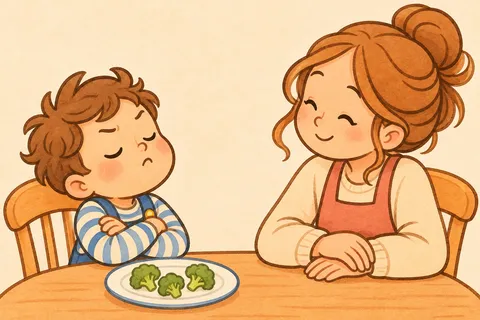
Fish balls are one of those foods children often refuse for a long time. It is the texture, and that takes time. The fish balls can sit on the table anyway. Your child can look at them, cut them, press them. That is part of getting to know them too. More in when they say no.
Fried instead of poached
Fish cakes are made from nearly the same mixture, but fried. They are firmer with a brown crust, and many children who back away from fish balls like fish cakes. You can also slice fish balls and fry them in a little butter. They go golden at the edges and less spongy. Fish gratin is another mild fish in white sauce.
In Mumse your child earns a star for tasting fish balls, even if the thumb pointed straight down. It is the courage that counts, not whether the fish ball went down well. More about Mumse.
 Fish balls
 Fish soup
 Cauliflower
 Fish gratin
 Prawns
 Meatballs