Prawns
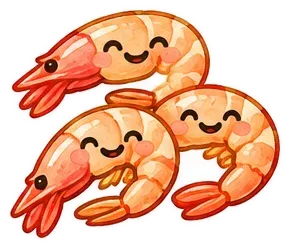
A cooked prawn looks you in the eye. It has long feelers, lots of tiny legs and a curled-up tail. To some children that's fascinating. To others it's reason enough to stay away.
- Taste
- sweet, salty, mild
- Texture
- smooth, chewy





Read aloud to your child
Prawns are little shellfish that swim in the sea. When cooked they are pink with a curved back. You can peel off the shell yourself, and underneath the meat is firm, sweet and mild. They look like tiny crescent moons on a plate.
There’s quite a lot of animal in a prawn. Two black eyes, a shell like a little suit of armour, lots of thin legs, two long feelers and a fan-shaped tail. When they’re piled on a platter, you see all of it at once.
No wonder some children hesitate.
Start with a peeled one
There’s no rule saying children have to peel before they taste. For a child who finds prawns scary, a ready-peeled prawn can be the easier first meeting. All that’s left is a small pink-and-white crescent. No eyes, no legs.
Prawns in brine, sold in jars and pouches in Norway, come already peeled. They’re milder and a little softer than fresh prawns, and a good start. After that you can try fresh ones, peeled by a grown-up.
The taste is mild, slightly sweet and slightly salty. The flesh is firm and smooth and a bit springy between the teeth.
Learning to peel
Peeling prawns is a skill, and lots of children are proud when they master it. The first prawn is rarely tidy. That’s fine. The tenth is better.
- Hold the prawn with one hand round the head and one round the body.
- Twist off the head.
- Pull the shell away along the belly, where the legs are.
- Squeeze the tail gently and the last bit slides out.
Many children peel for a long time before they taste. Some peel for the grown-ups all evening and never taste one. That’s still getting to know prawns: feeling the shell, seeing how they’re built, smelling the sea on your fingers.

Why they’re pink
Raw prawns aren’t pink. They’re greyish and nearly see-through. The pigment is there, but it’s bound to protein and hidden. When the prawn is cooked, the protein lets go and the pink appears. The same happens with lobster and crab.
In Norway most people buy prawns already boiled, often straight off the boat or from the fishmonger, so children rarely see a raw one. Perhaps in an aquarium one day.
Prawns that change
The prawns Norwegians eat most, northern deep-water prawns, have a secret. They all start life as males. After a few years, they become females. A big prawn with roe under its tail has been both.
That’s one of those facts children love to pass on, ideally at the dinner table.
Prawns day to day
Apart from Friday evening prawns with white bread and mayonnaise, prawns end up on open sandwiches, in pasta, in tacos, in paella and in Asian noodle dishes. Cooked into a hot dish they firm up and taste less of the sea. For some children, a prawn in a familiar pasta dish is a small step, because the rest of the plate is safe.
Small steps
- Look at a whole prawn. Count the legs.
- Feel the shell. Hard or soft?
- Peel one, or watch a grown-up do it.
- Taste a prawn from a jar.
- Taste a fresh peeled prawn with a squeeze of lemon.
The heads can wait
Don’t push your child to look at the heads if they don’t want to. Put peeled prawns on a separate plate. Let your child help with whatever they dare, even if that’s just holding the bowl for the shells.
In Mumse tasting earns a star, even if it was that first, badly peeled prawn with half the shell still on.
 Mayonnaise
 Smørrebrød
 Fish soup
 Lemon juice
 Nigiri




