Cauliflower
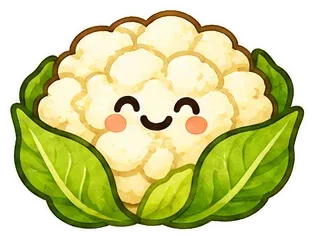
Cauliflower looks like a white cloud or a tree with no leaves. It is milder than broccoli, but it has a cabbagey smell that can fill a whole kitchen.
- Taste
- mild, bitter
- Texture
- crunchy, soft, grainy



Read aloud to your child
Cauliflower is a big head of tight white buds that look like clouds or little trees. It grows on a plant with big green leaves that wrap around the head. Raw it is crunchy and mild, cooked it is soft. The taste is gentle and a little nutty. Feel the tiny bumps on the surface.
Hidden in the leaves
Buy a whole cauliflower with its leaves still on and fold them back with your child. Inside sits a tight white head, the beginnings of the plant’s flowers, packed together before they have had the chance to open. While the cauliflower grows, those big green leaves wrap around the head and shade it from the sun. That is why it stays white.
It is a good thing to show a child before anyone tastes. A vegetable that hides is more interesting than one that just sits there.
Mild, with an edge
Cauliflower tastes mild, slightly nutty and a little sweet, with a faint bitter edge. It is gentler than broccoli, its close relative, which makes it an easier first cabbage for many children.
But cauliflower smells. Boil it too long and it gives off a sulphurous cabbage smell that lingers in the house. For a child sensitive to smells, that can be enough to put them off sitting at the table. It is not the child being difficult. It is the smell being strong.
Less smell, more flavour
How you cook it makes a big difference:
- Raw. Small florets, crunchy and mild. Almost no smell.
- Briefly boiled or steamed. Five minutes, until tender but still holding its shape.
- Roasted. With a little oil, until the edges turn golden. The bitterness drops and it gets sweeter.
- Mashed. Cauliflower mash is smooth and mild and feels much like mashed potato.
Long boiling leaves it limp and soggy, and that is the version many adults remember from childhood. It is not the one to start with.
Crumbs and clouds
Raw cauliflower has a texture all its own. It crunches, but it also crumbles. Bite a floret and little white crumbs fall onto the plate. Some children like that. Others find it odd that food falls apart.
Let your child hold a floret and feel the surface. It is bumpy, covered in tiny balls. Does it look like a cloud? A sheep? A tiny brain? There are no right answers, which is the nice thing about it.
Not just white
Cauliflowers come in other colours too. Orange, purple and green ones look completely different on the plate but taste much the same. Romanesco belongs to the same family and has pointed spirals for florets. If you spot a coloured cauliflower in the shop, it is worth bringing home. A child who has said no to white cauliflower may be curious about a purple one.
In Nordic dinners
In Norway, cauliflower often sits beside fish and potatoes, sometimes under a white sauce, or baked into a gratin. Cauliflower soup is common too. Many children first meet it as part of something bigger, next to something familiar. That is a fine way to do it, as long as your child knows what they are eating. Say it: “There’s cauliflower in this today.”
Do not count florets
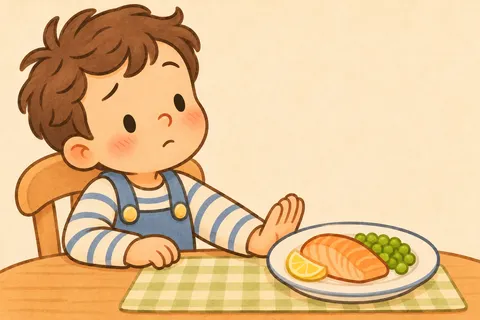
It is tempting to say “just one more bite”. Resist. Put a small floret on the plate, eat your own, and let your child decide what to do with theirs. Some children need many meals where the cauliflower simply sits there.
The guide on how many times children need to taste something has more on this.
In Mumse every taste earns a star, and after five different days the cauliflower turns into gold food on the shelf.
 Broccoli soup
 Veggie sticks
 Fish gratin
 Potato
 Vegetable soup