Parsley
Parsley is rarely the main event. It's the green flecks on the potatoes, or the sprig beside the fish. And those green flecks are often exactly what children pick off before eating.
- Taste
- mild, bitter
- Texture
- crunchy, stringy



Read aloud to your child
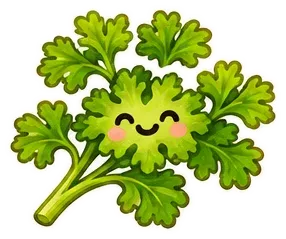
Parsley is a green herb with curly or flat leaves, a bit like tiny green feathers. It smells fresh and green, and the taste is mild and a little peppery. People often sprinkle it on food as decoration. Rub a leaf between your fingers and sniff it.
The green on the potatoes
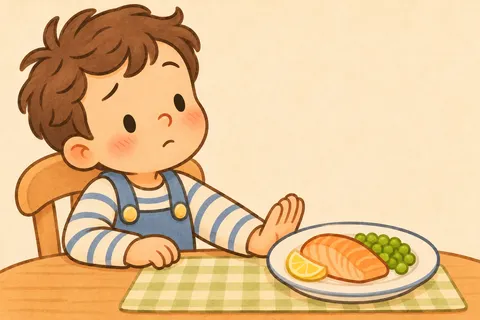
Boiled potatoes with butter and chopped parsley is a Norwegian dinner many children know. Plenty of them eat the potatoes and leave a thin layer of green on the plate. Not because the parsley tastes bad. Because it’s green, it’s in tiny pieces, and it’s sitting on something that used to be safe.
Children going through a phase of wanting their food “clean” react strongly to flecks and sprinkles. It’s a common stage, especially between two and six. Parsley is often first in the firing line, because it’s everywhere.
Give parsley its own place
The simplest thing is to lift the parsley out of the food. Put it in a little bowl on the side, or on its own plate. Then the potatoes are clean, and the parsley is something your child can choose to use.
That might sound like a step backwards. But a child who sprinkles one pinch of parsley on their own potato has done something much bigger than a child who had it put there and picked it off.
Rub and sniff
Herbs aren’t really meant to be eaten in large amounts. They’re meant to be smelled. That makes them a good tasting game, because the first step can be just the nose:
- Rub a parsley leaf between your fingers and sniff your fingers.
- Do the same with dill and basil if you have them. Which smells strongest?
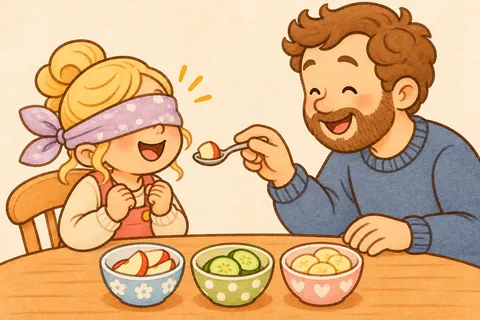
- Close your eyes and guess which herb is being held under your nose.
Parsley smells fresh and green, a bit like cut grass. It tastes mild with a faint bitter edge, and a sprig can crunch slightly.
Curly or flat
There are two common types. Curly parsley has dense, crinkly leaves and looks like tiny green trees or a cloud. It’s mild and firm, and children often like holding it. Flat-leaf parsley has flat leaves, a bit like carrot tops, and a stronger flavour.
Let your child hold a sprig of each. Which is softer? Which smells more? Curly parsley is often easier to make friends with, because it’s fun to look at.
A herb on the windowsill
Parsley is easy to grow. A pot from the supermarket can sit on the windowsill for weeks, and your child can be in charge of watering it. It’s another way of getting to know food: you see it every day, you look after it, and one day you snip a sprig for dinner.
Few children want to taste a plant they don’t know. A few more want to taste their own.
Parsley is related to both carrots and dill, by the way. Can your child smell the family likeness?
Parsley in Norwegian food
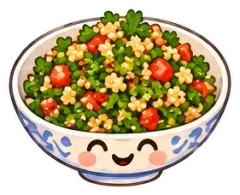
Besides parsley potatoes, parsley goes on boiled fish, in fish soup, in parsley butter for steak and salmon, and into meatball mixture. It’s also the main ingredient in tabbouleh, a Middle Eastern salad where parsley isn’t decoration but the salad itself.
When your child picks it off
Let them. It’s fine. Put the parsley on the table every time, in its own bowl, and sprinkle some on your own plate. Over time the green becomes an ordinary part of the table.
When your child tastes a parsley leaf, that’s as much courage as tasting something big. In Mumse it earns a star, and the shelf doesn’t mind that it was only a small sprig.
 Tabbouleh
 Coriander
 Potato
 Cress
 Dill