Greek salad
Half of a Greek salad is food your child probably eats already. The other half is salty, white and black.
- Taste
- salty, tangy, mild
- Texture
- juicy, crunchy, grainy



Read aloud to your child
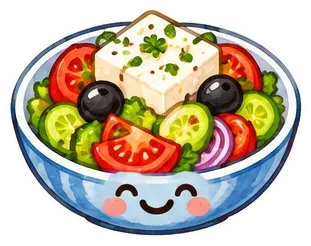
Greek salad is big chunks of tomato, cucumber, red onion and olives, with a white block of feta cheese on top. Everything is juicy and fresh, and the cheese is salty and a little crumbly. The oil glistens on top. It is eaten a lot on hot days in Greece. Can you find the round black olive?
Tomato and cucumber. Most children have had both, sliced on bread, in sticks in a lunchbox or chopped at dinner. In a Greek salad they’re simply cut bigger, in rough chunks, and they share the bowl with red onion, green pepper, black olives and a white block of cheese on top.
So a child looking at a Greek salad sees something familiar and something unfamiliar on the same plate. That’s a good place to begin.
Sort the salad
Give your child an empty plate and let them sort. Tomato in one pile, cucumber in another, onion in a third, olives on their own and the feta at the edge. Sorting is a game for many children, and it lets them handle everything without anyone asking them to eat.
Once it’s sorted, starting with the familiar is easy. Then your child can decide whether to try any of the rest.
The feta
Feta is a white cheese from Greece, made from sheep’s milk, often with some goat’s milk. It’s salty, a little tangy and crumbles when you cut it. In a proper Greek salad it sits on top as a whole slab, with oregano and olive oil over it, and you break it with your fork.
Children used to mild cheese are often surprised by how salty feta is. Tasting it with a piece of tomato can help. The tomato is sweet and juicy and takes the edge off the salt. You could ask: “Is it saltier than the sea?”
The olives
Olives are one of the hardest tastes for children. They’re salty, a bit bitter, and firm and slippery at once. Greek kalamata olives are dark purple, nearly black, and have stones. Stones and whole round olives can be a choking risk for small children; take the stone out and cut the olive up, and ask your health visitor if you’re unsure.
Olives can stay something your child only looks at for a long time. Plenty of adults learned to like them late. But sniffing one, or licking it, is a real small step.
The juice at the bottom
At the bottom of the bowl, tomato juice, olive oil and salt from the feta collect together. In Greece many people mop it up with bread. It’s one of the best bits, and it’s good for a child who’s wary of the rest. A piece of bread dipped in the salad juice tastes of tomato, oil and a little salt. It’s a taste of the whole salad without eating a single chunk.
On holiday in Greece
Many Scandinavian families spend summer holidays on Crete, Rhodes and the other Greek islands, and Greek salad is on every table. It’s eaten on hot days, often at lunch, alongside grilled fish or a gyro. The vegetables are ripe and sweet because they grew in the sun nearby. To plenty of children a tomato on Crete tastes nothing like a supermarket tomato in February, and that can be what makes the salad interesting.
At home
At home it’s easy to make a gentler version. Use sweet cherry tomatoes cut in half, peeled cucumber, and crumble a little feta over instead of a whole block. Red onion can soak in cold water for a while, which makes it less sharp.
The feta counts
If your child tastes the feta, that’s a star in Mumse, even if the cucumber was the only thing that went down. The thumb can point down. It was brave all the same.
 Tzatziki
 Halloumi burger
 Tabbouleh
 Iceberg lettuce
 Gyro