Fish fingers
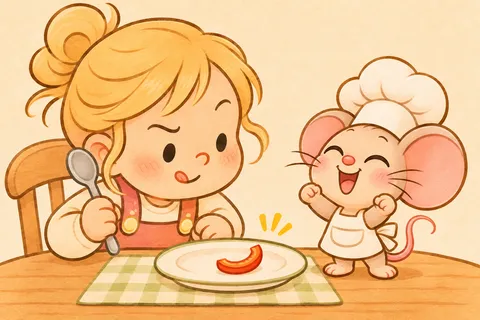
For many children, fish fingers are the first fish they eat willingly. The coating does the work. Inside is an ordinary piece of white fish, and that's the part you can build on.
- Taste
- mild, salty
- Texture
- crunchy, soft




Read aloud to your child
Fish fingers are long pieces of white fish with a golden, crispy coat. They are just the right size to hold in your hand. The coat crunches, and inside the fish is soft and mild. Lots of children eat them as one of their first fish meals.
The same every time
A fish finger never surprises anyone. It’s golden, straight and exactly the length of a small hand. It crunches. It doesn’t even smell of fish until you snap it in half.
That’s why it works. Children who are wary of fish are rarely wary of fish fingers. The real question is where you go next.
Snap one open
Break a fish finger in two and look inside together. There’s white fish in layers, with thin flakes that come away if you tug at them. Most fish fingers are cut from big frozen blocks of fillet, coated, part-fried and frozen again. So it’s real fillet in an unusual shape, not a paste like the one in fish cakes.
The packet says which fish. Many are cod. Others are saithe, or Alaska pollock, which belongs to the cod family and is caught in the Pacific. Read the packet with your child: “It says cod. Same fish as the one at the fish counter.”
They were nearly herring
Fish fingers went on sale in Britain in 1955, made at a factory in Great Yarmouth. After the war there was plenty of herring about, and the first version that went out to be tested was herring. The people who tried it preferred cod. The name came from a vote among the factory staff.
It’s a good story for the dinner table. If the people who tried them in the fifties had liked the herring better, the box in your freezer might taste of herring.
Coating and fish, one at a time
For some children the coating is the fish finger, and the fish is just something that comes along with it. You can use that.
- Peel off a bit of coating. Taste a piece of plain fish. Mild, white, a little salty. No surprises.
- Taste only the coating. It tastes of breadcrumbs and frying. That’s where the salt and the crunch live.
- Put them back together. Now your child knows which part tastes of what.
It sounds fussy, but children who know what they’re eating tend to relax. The fish stops being something that hides.
Make a batch yourselves
Homemade fish fingers make a good halfway house. Cut cod or saithe into finger-thick strips. Set out three bowls in a row: flour, beaten egg, breadcrumbs. Children love a production line, and the sticky fingers are the fun kind. Fry them or bake them.
They won’t be as straight as the frozen ones. They’ll be thicker, juicier and taste more of fish, which is rather the point. Your child has made fish fingers from a fish they’ve seen as a fillet, maybe even whole.
Ketchup, tartare sauce, or nothing
Plenty of children eat fish fingers with ketchup and not much else. That’s fine. Put a small bowl of tartare sauce or soured cream next to it and say nothing. One day a finger gets dipped in the wrong bowl.
Try one fish finger with nothing at all, too. It tastes more of fish that way, which is useful to know when you want to move on.
Where to go from here
Fish and chips is the same idea with a different coat. After that, cod pan-fried with a little flour, and then plain cod. Each step takes away a bit of crunch and adds a bit of fish. There’s more on small steps in how to get children to try new foods.
Fish fingers are in Food World in Mumse. One eaten without ketchup, or with a new sauce, can count as a tasting. You decide together what counts as new.
 Fish cakes
 Chicken nuggets
 Cod
 Fish taco
 Fish gratin