Saithe
Saithe is the slightly greyer cousin of cod. It's often in the fish cakes children already like, so it's rarely completely new. It just hasn't had its own name on the plate yet.
- Taste
- mild, salty
- Texture
- soft, juicy




Read aloud to your child
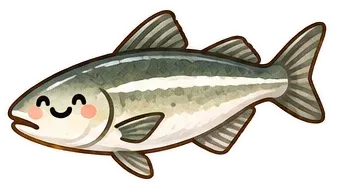
Saithe is a fish in the cod family that swims in big schools in cold, clear seas. Its back is dark greenish-grey, its belly silvery white, and along its side runs a straight, pale stripe. Saithe has no spots and no whisker like a cod. The flesh is grey when raw, but turns white and mild when cooked. Can you find the stripe?
A fish your child has probably eaten
In Norway, saithe is everywhere without anyone mentioning it. Many fish cakes are made from saithe or haddock, and some fish fingers are saithe too. In Britain you’ll mostly find it sold as coley. Plenty of children have eaten it already without knowing its name.
So tell them. “There’s saithe in your fish cakes. Today we’re having it before it got minced.” That’s a bridge from something familiar to something new, and the fish stops being a stranger.

Grey becomes white
Put a raw saithe fillet next to a raw cod fillet. The cod is glossy and nearly white. The saithe is grey, almost bluish. A lot of children say “yuck” straight away, which is a fine place to start, because what happens in the pan is a surprise.
Fry a piece and watch it together. After a few minutes it’s white. Not quite as snowy as cod, but white enough that the change is obvious. It’s a small transformation, and children who have watched it are often curious about the result.
Saithe has darker muscle than cod. The same idea explains why chicken thighs are darker than chicken breast: muscles that work hard get more colour. The grey says nothing about freshness.
Find the stripe
If you can see a whole saithe, look for the stripe. A straight, pale line runs along each side from head to tail. The back is dark greenish-grey and the belly silvery white. Saithe has no spots and no little whisker under the chin, which is how you tell it from a cod.
The stripe is a sense organ. The fish feels movement in the water with it, which helps a whole shoal turn at once. That’s a good answer for a child who wants to know what the line is for.
Off the rocks
Along the Norwegian coast, saithe is one of the fish people most often catch in summer, from a boat or straight off the rocks. Small saithe swim in shoals close to land and bite readily. A child who has reeled in a fish of their own sees the one in the frying pan that evening quite differently.
If you don’t fish, ask at the fish counter whether they have a whole one to show you.
How it tastes
Saithe tastes a little more of fish than cod, but it’s still mild. The flesh is firm and juicy and breaks into flakes, slightly smaller than cod’s. Pan-fried with a coat of flour or breadcrumbs, it’s mild and salty, an easy first version.
Norway has an old dinner called seibiff: saithe fried with lots of onion cooked slowly until it turns sweet, often with gravy and potatoes. The onion can be harder for some children than the fish. Serve it on the side.
Boiled saithe with potatoes and melted butter is another old Norwegian dinner. It tastes more of fish and suits a child who has come a little way already. See poached fish with potatoes.
Lots of small goes
Saithe is an everyday fish and often cheaper than cod, so it can come round often. That helps. Children need many meetings with a food before it feels familiar, and a fish that keeps turning up gives plenty of chances. More on that in how many times do children need to taste.
Saithe is in Food World in Mumse, and the passage you can read aloud asks your child to find the stripe. After five tastings it becomes gold food.
 Cod
 Fish cakes
 Poached fish with potatoes
 Fish fingers
 Gravy
 Fish gratin