Chicken breast
Most children are fine with the taste of chicken. What puts them off is a dry, stringy piece that seems to get bigger the longer they chew.
- Taste
- mild
- Texture
- juicy, stringy, dry



Read aloud to your child
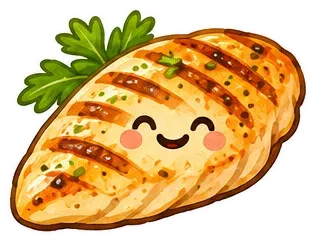
Chicken breast is the breast meat of a chicken, cooked until it is white and tender. It tastes mild and is easy to chew. You can cut it into strips or cubes, or eat it whole. It goes with almost anything, from pasta to salad. Look how white the meat is inside.
Watch the chewing
Ask a four-year-old why they won’t eat the chicken and you will rarely get an answer. Watch their jaw instead. A thick piece of breast that spent a few minutes too long in the oven goes dry and stringy. The child chews, and chews, and the piece does not get any smaller. It ends up parked in a cheek, or back in their hand.
That is not fussiness. It is a mouthful that is genuinely hard to swallow.
Breast is the leanest part of the bird. There is almost no fat in it, and fat is what keeps meat moist, so it goes from juicy to dry in a matter of minutes. Thigh meat is darker and richer and far more forgiving. Plenty of children who refuse breast will happily eat thigh without realising it is the same animal.
A taste that borrows
Cooked chicken breast tastes of very little on its own: a bit salty, a bit browned, mild. That is useful. It takes on whatever it is cooked with, whether that is soy sauce, taco seasoning or a creamy sauce. Inside it is white, and the fibres all run one way, so it pulls apart into strips.
For a child who likes things predictable, this is oddly unsettling. Chicken looks completely different from one meal to the next. Breaded chicken, chicken in a stew, sliced chicken on bread and a grilled drumstick are four separate foods to a four-year-old, even if the adults call them all chicken.
Things that help
Cut across the grain. Turn the fillet and slice across the fibres. The pieces come out short and far easier to chew. Strips cut along the grain turn chewy.
Thin and quick. A flat strip fried for two or three minutes stays juicier than a thick chunk from the oven. Put the breast in a freezer bag and flatten it with the bottom of a saucepan. Children tend to volunteer for this job.
Shred it. Poached chicken pulls into soft threads with two forks, and a child can do the pulling. A lot of children eat shredded chicken in a wrap long before they will take on a whole piece.
Give it a dip. Soured cream, yoghurt with a pinch of salt, or a sauce they already trust. A dip adds moisture, and your child decides how much.
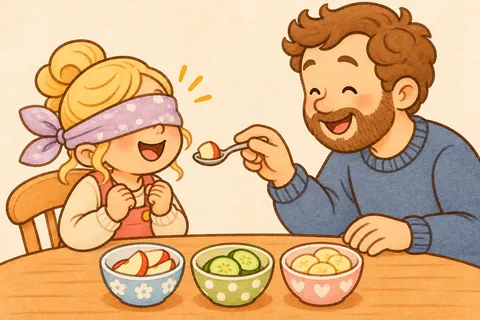
Put two pieces side by side. One bit of thigh, one bit of breast. Which is darker? Which is softer? There are more ideas like this in tasting games.
Raw chicken is the exception
Having your child in the kitchen is a good thing. Raw chicken is the one thing they should not taste. It has to be cooked through with no pink inside, and hands and boards get washed after touching it. Let them season it and lay the pieces in the pan, then wait.
Chicken in Norway
A few decades ago Norwegians ate surprisingly little chicken. Now fillets are in almost every shopping basket and turn up in tacos, stir-fries, pasta sauces and on open sandwiches. Which means many children have already eaten chicken without noticing. If it was in the stir-fry with the noodles, it counts.
A stir-fry is often a good place to begin. Small pieces, plenty of sauce, rice on the side. The chicken tends to be the first thing a child manages to spear, simply because it is the easiest thing to get on a fork.
Next door
Once chicken feels ordinary, other mild foods are close by. Norwegian meat patties are softer and juicier. A sausage is just as mild, but the skin snaps when you bite.
In Mumse, chicken breast sits on the meat and poultry shelf. Your child earns a star for tasting it, even if the thumb points down. Read about Mumse.
 Chicken and rice
 Chicken nuggets
 Chicken pasta
 Chicken tikka masala
 Chicken soup