Traybake pizza
Pizza baked on the oven tray is its own thing. It's thicker than a pizzeria pizza, it has crisp corners and soft middles, and it's cut into squares everyone can point at.
- Taste
- salty, mild, savoury
- Texture
- soft, crunchy, stringy


Read aloud to your child
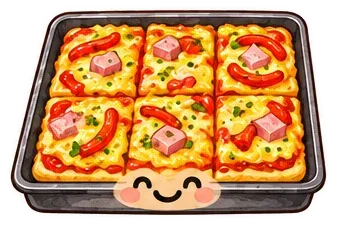
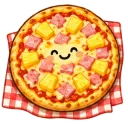
This pizza is not round but square, because it is baked on a long baking tray in the oven. It is cut into squares, so everyone can take their own piece. There is red tomato sauce, melted cheese that makes long strings, bits of ham and sweet, colorful pepper. Many families make pizza at home on Friday. Can you share it into as many pieces as there are people?
In Norway the word is langpannepizza: long-tray pizza. It’s the pizza people make at home on the big oven tray, rather than the round one from a pizzeria. The dough is pressed out to fill the whole tray, then tomato sauce, grated cheese and whatever the family usually has: mince, ham, peppers, sweetcorn, onion. It’s thicker than a Neapolitan pizza and comes out of the oven to be cut into squares.
A round pizza is cut into triangles. A tray pizza is cut into a grid. That sounds like a small difference. At the dinner table it isn’t.
Corner or middle
The first thing children tend to notice is that the pieces aren’t the same. A corner has crust on two sides. It’s crisp and a little dry, with less sauce. The middle pieces are soft and juicy and carry the most cheese.
Plenty of children have strong views on this. Some will only eat corners. Others find the edge hard and want the middle. That isn’t fussiness, it’s texture, and it’s a nice way into talking about how food feels in your mouth.
Ask: which piece crunches loudest? Which one has the longest cheese strings? Neither question has a right answer.

A square each
The good thing about a tray is that it can be divided before it goes in the oven. Press a line into the dough with the back of a knife, or simply agree who owns which corner. Then everyone tops their own patch.
That does several useful things. Your child is in charge of their own pizza. They can see what everyone else is putting on. And it’s easier to be brave on a small patch than on a whole pizza.
One rule that works for some families: everyone puts one thing on their patch that they don’t usually have. For your child it might be one slice of mushroom, a few pieces of red pepper or three olives. For you it might be pineapple. Nobody has to eat the new thing, but it has to be there.
Dough on your fingers
Pizza dough is good modelling clay. Your child can press it into the corners, feel how stretchy and springy it is, and watch it rise in the heat. Cheese can be sprinkled by hand, and sauce spread with the back of a spoon.
Children who helped make the food see it differently when it comes out of the oven. They’ve touched everything on it. The new topping isn’t a stranger any more. It’s something they put there.
Friday, again and again
In a lot of Norwegian homes, pizza is Friday food. That makes it a fixed point in the week, and fixed points are handy. If the new topping turns up on the tray week after week, it slowly becomes part of Friday.
Mushrooms every Friday for a month means your child has seen mushrooms four times, touched them maybe twice and tasted them once. That’s how it goes. How many times it takes varies, but it’s usually more than you’d hope.
There’s a separate page on round pizza, and one on the pineapple question: Hawaiian pizza.
In Mumse, your child can take a picture of their square before eating it, new topping and all. Tasting that piece earns a star, even if the new thing was picked off after the first bite.
 Pizza
 Hawaiian pizza
 Ham
 Pide
 Mushroom
 Taco pie