Sour sweets
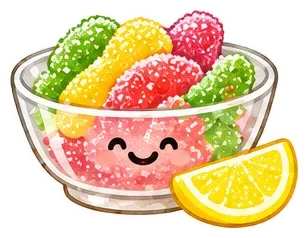
First the mouth puckers and the eyes squeeze shut. Then it passes, and what is left is sweet and chewy. Sour sweets are a small surprise in two parts.
- Taste
- tangy, sweet
- Texture
- chewy, grainy



Read aloud to your child
Sour sweets have a layer of sour sugar that makes your mouth pucker and your face pull funny expressions. Underneath the sour part there is something sweet and chewy. See who can make the funniest face.
Watch the face. That is the first thing that happens when a child puts a sour sweet in their mouth. The eyes screw up, the nose wrinkles, and the whole body looks as if it wants to shrink. Then, after a few seconds, everything relaxes again.
Sour sweets are almost more of an event than a taste.
The powder on the outside
The sourness sits in a coating. It is sugar mixed with acids such as citric acid and malic acid, the same ones you find in lemons and apples. The coating gives the sweet a slightly gritty surface, like sand on the tongue. Inside there is usually an ordinary sweet, chewy middle.
That is why the sourness fades so fast. Saliva dissolves the thin layer and washes it away, and the sweet part comes through. The whole thing lasts only a few seconds, and it is easy to notice if you take your time.

Feel where it lands
Try following it on the tongue. Does the sourness arrive at once, or after a moment? Is it at the tip, along the sides, at the back? When does the sweetness turn up?
Children can describe it in their own words. Some say it itches, others that it stings, or that it is like biting a lemon. There are no wrong answers. What matters is that your child notices instead of just reacting.
The straight-face game
The face is half the fun. Let everyone take one and look at each other. Who can keep a straight face longest? It is close to impossible, which is the whole point.
The game works just as well with a wedge of lemon or a sprig of redcurrants as with sweets. It can even be a nice bridge. A child who thinks sour sweets are a laugh may enjoy testing a redcurrant or a gooseberry the same way. The sourness is real, and the face comes just as fast.
When it is too much
Not every child likes sour. For some it is unpleasant, almost alarming, and they spit it straight out. That is a completely normal reaction. Sour is a taste the body pays close attention to, and it is fine not to like it.
Some research suggests that a fair share of children tolerate and enjoy stronger sourness than most adults. That might explain why some children go for the sourest sweets in the bag while their parents shake their heads. It does not apply to every child, and it does not have to.
Say it beforehand: this one is sour, and then it goes sweet. A child who knows what is coming is more willing to try.
Sour without sweets
Sourness turns up in plenty of ordinary food. Lemon juice is sour in its purest form. Redcurrants and gooseberries are tart berries that grow in Norwegian gardens, and they make the mouth pucker much like the sweets do. Gummy bears often come in sour versions too, with the same powder on the outside.
Sour sweets are among the sweets in Mumse. It is the courage that earns a star, not whether your child liked it.
 Gummy bears
 Gummy men
 Liquorice
 Kiwi
 Red liquorice
 Gooseberry