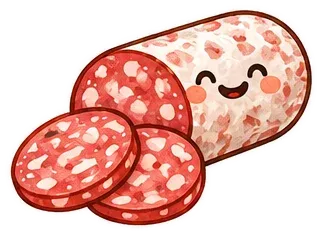
Salami
Salami is a sausage that has never been cooked. It's salted, spiced and hung up to dry until it's firm enough to slice so thin you can almost see through it.
- Taste
- salty, savoury, spicy
- Texture
- chewy, dry



Read aloud to your child
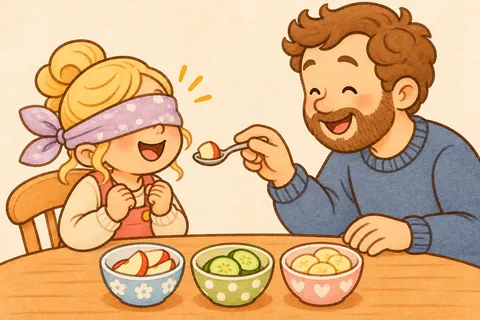
Salami is a dried sausage that is cut into thin, round slices. It is red or brown with little white dots, and it tastes a bit salty and spicy. It comes from Italy originally. Lots of people know it from pizza. Try counting the dots on one slice.
Spot the spots
Hold a slice of salami up to the window. It’s dark red, almost brown, and full of white dots. The dots are fat. Around the edge is a thin skin. If the slice is thin enough, a little light comes through.
That’s plenty to look at before anyone tastes it. Count the dots. Find the biggest one. Compare it with a slice of ham, which is pink and even with no dots at all. Two cold meats that look nothing alike.
A sausage that’s never cooked
Salami is a dried, cured sausage. The meat is chopped, mixed with salt, spices and fat, packed into a casing and hung up to dry for weeks or months. It’s never boiled or fried. The drying and the salt are what keep it.
That’s why it’s so different from a frankfurter. The sausage your child knows is cooked, soft and juicy. Salami is firm, dry and chewy, with a far stronger taste. It’s a useful explanation to have ready when your child says “but it’s just sausage” and then looks surprised.
Many salamis have a white, powdery coat on the outside. That’s a mould that’s part of the drying. The skin usually comes off before slicing or eating.
From Italy, and closer to home
Salami comes from Italy, where there are many kinds, from fine and mild to coarse and fiery. The name is linked to the Italian word for salt, sale. Norway has its own tradition of dried sausage, spekepølse, often eaten with flatbread and soured cream, or sliced on a hike. Same idea: meat preserved with salt and air.
Thin is easier
The simplest rule with salami: the thinner, the easier. A thick slice is chewy and the flavour arrives all at once. A thin one almost melts and tastes milder.
- Cut it into strips. Long, narrow strips make it easy to take a tiny bite.
- Roll a slice. A salami roll with a piece of cheese inside is a small, familiar meal on a fingertip.
- Fold it onto a cracker. The cracker is crunchy and plain, and the salami sits on top.
- On bread with cheese. Half a slice of salami on the cheese. Your child can take it off again.
On pizza
Plenty of children have eaten salami without noticing, on pizza. In the oven the slices crisp at the edges and the fat melts into little orange pools. The taste gets rounder.
That can be a way in. A child who eats pepperoni pizza has already eaten a kind of salami. Next time, put a cold slice beside the pizza and taste both.
Strong taste, small bites
Salami is salty, seasoned and sometimes hot. Some kinds have chilli or plenty of pepper. It’s no wonder lots of children find it too much at first, and that’s not a problem.
Strong flavours often need many small meetings. A strip today, another next week. There’s more in how many times do children need to taste.
One dot at a time
Salami is on the meat and poultry shelf in Mumse. A small strip is enough for a star. The passage you can read aloud asks your child to count the dots on a slice, which is a decent place to begin.
 Pizza
 Bread with cheese
 Olives
 Bacon
 Bread with liver pâté