Bread with cheese
A slice of bread with cheese looks like one thing, but it is three: the bread, the butter and the cheese. When a child turns it down, usually only one of them is the problem.
- Taste
- mild, salty
- Texture
- soft, chewy



Read aloud to your child
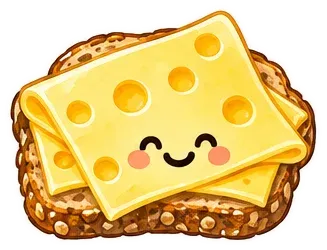
Bread with cheese is simple and tasty. Cheese is made from milk and is sliced thin with a cheese slicer. It can be pale yellow or white, and tastes mild and a little salty. Look for the holes that some cheeses have. Many people want the cheese slicer, because slicing is fun.
In Norway, bread with cheese is what many children eat most days: at breakfast, in the packed lunch and again at supper. It is an open sandwich, one slice of bread with butter and cheese on top, eaten with the hands or, by the more formal, with a knife and fork. Because it is everywhere, it is easy to forget it is food at all. But for a child who refuses it, it is worth looking at what is actually there.
Three layers
At the bottom is the bread. It might be soft and pale, or dense with grains and seeds. Then the butter, which children rarely notice, but which makes the slice smoother and a little saltier. On top is the cheese.
Ask what is wrong with it. The answer is often more precise than you expect. “There’s something hard in the bread.” “The cheese is too thick.” “It’s got butter on.” Each of those is easy to change, and your child learns that they were listened to.
You can also serve the slice in parts. Cheese alone on a plate. A piece of bread beside it. Your child tastes one, then the other, and puts them together if they want to.
Thick or thin
How thick the cheese is matters a lot. Norwegians cut it with a cheese slicer, a flat blade with a slot that shaves off thin sheets. A shaving almost disappears into the bread. A thick slice is chewy and salty and is the first thing your child notices. There is more about cheese and the slicer on its own page. On the bread, thickness is what counts. Offer one thin and one thick, and ask which is easier to chew.
The shape of the slice
A whole slice is big in a small hand. Cut it into fingers, squares or triangles. A narrow strip is easy to hold and ends in a bite that is mostly cheese. Squares can be laid out like a board, taken one at a time.
It is not a trick. It is the same slice. But a child who has decided bread is boring may look at squares differently.
Melted
Put the slice under the grill for a few minutes, until the cheese melts and bubbles at the edges. Now it is a different food. The cheese is soft and stringy, the edges go a bit crisp, and the taste rounds out. Plenty of children who won’t eat cold cheese will eat it hot.
The same thing happens in a grilled cheese, two slices fried in a pan with cheese between them. That can be the next step.
Jam on top
Norwegians often put jam on top of the cheese. To many visitors this sounds odd. Sweet and salty, mild and sharp, all at once. For a child who likes jam, it may be what makes the cheese possible. Keep the layer thin, so the cheese still has a say.
After a morning in a lunchbox
Cheese that has spent a few hours in a lunchbox is not the cheese that left the fridge. It goes softer and slightly shiny, and the bread underneath gets softer too. Some children like it that way. Others find it unpleasant. That may be why a slice comes home untouched, and it is a useful thing to know.
When the bread is the hard part
If the bread is what your child objects to, there are other routes: crispbread, a thin lefse, a bread roll or a paler loaf. A seedy wholemeal bread can come later, once the cheese feels safe.
In Mumse, your child gives the slice a thumb up, down or somewhere in between after tasting it. The star is the same whichever way the thumb goes. About Mumse.
 Cheese
 Bread with brown cheese
 Ham
 Quesadilla
 Crispbread