Bread with jam
Few children need help tasting jam. But the jar is a useful way into other things: the berries it was made from, and everything else jam can sit on.
- Taste
- sweet, tangy
- Texture
- smooth, soft



Read aloud to your child
Bread with jam is sweet and sticky in a good way. Jam is made from berries or fruit cooked with sugar until it turns thick and shiny. It can be red like strawberries or dark like blueberries. Look how it glistens. Spread it thinly and you can taste both the bread and the berries.
Red, glossy and running slightly over the edge of the bread. Jam is one of the toppings many children take without hesitating. It is sweet, it is soft, and it is the colour of something good.
Still, the jar can do a lot more than make a slice sweet.
Berries cooked with sugar
Jam is berries or fruit cooked with sugar until thick and shiny. Cooking softens the fruit, and the sugar keeps it in the jar for months. Strawberry, raspberry, blueberry and apricot are common, and many Norwegians make their own in summer and autumn.
Norway also has rørte bær, stirred berries: berries mixed with sugar and never cooked. They taste fresher and more of the berry, and they are runnier. Stirred lingonberries are the classic.
Put a jar of jam next to a bowl of the same berries. Your child can taste both. One is sweet and smooth. The other is sharper, colder, maybe a little crunchy. Same berry.

The seeds
Strawberries and raspberries have tiny seeds, and they end up in the jam. Some children pick them out with a fingernail, or refuse the jam altogether because there is something hard in it. Others never notice.
If the seeds are the issue, there are jams without visible seeds, and jelly, which is strained. The seeds can come back later. A good way is to let your child see them on a fresh strawberry first, on the outside, where they make sense.
Thin or thick
A thin layer of jam lets the bread taste of something. A thick one takes over. Both are fine. But if your child is going to try something new underneath, like cheese or a darker bread, a thin layer is what makes it work. Then they can taste both.
In Norway, bread with cheese topped with jam is an ordinary breakfast. Salty and sweet together. For a child who trusts the jam, the cheese underneath is a small step.
Jam on more than bread
Jam is a bridge. It can go on a waffle, in a pancake, on porridge or beside a bowl of rice porridge. It is familiar, and when it sits on something new, the new thing is a little less strange.
Not everything, of course. Jam on a sausage is odd even to a child. But lingonberry jam with meatballs is entirely normal in Scandinavia, and a good example of something sweet belonging at dinner.
A tasting game with jars
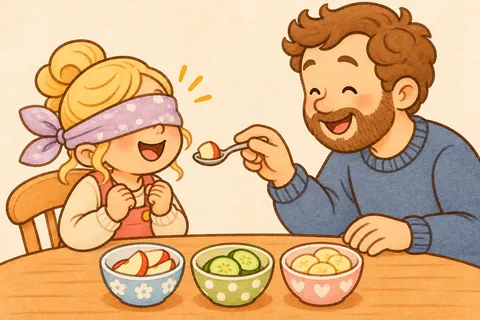
Find three different jams and put them on the table with a teaspoon in each. Your child tastes with their eyes closed and guesses the berry. It is harder than it sounds, especially between strawberry and raspberry. There are more games like this in tasting games.
Make some
Jam is simple. Berries and sugar in a pan, boil, stir, and watch it thicken. The pan gets very hot, so your child can stand beside you and watch, and help rinse berries and measure sugar. Once it has cooled, taste it from a spoon and compare it with the shop-bought jar.
Back to the berries
From jam it is a short step to fresh, whole raspberries and strawberries. The same tastes, in a different form.
In Mumse, a taste of jam is worth exactly what the first taste of something completely new is worth: one star. It is the courage that counts, not how easy the food was. About Mumse.
 Raspberry
 Waffle
 Strawberry
 Pancakes
 Bread with peanut butter
 Red berry pudding with cream