Moussaka
Moussaka is a lot like lasagne, only the pasta sheets are swapped for aubergine. For a child who likes lasagne, half the work is already done.
- Taste
- mild, salty, savoury
- Texture
- soft, creamy, juicy



Read aloud to your child
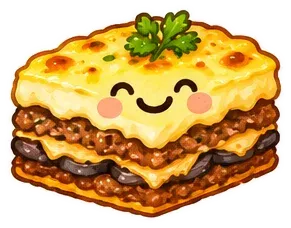
Moussaka is a Greek dish made in layers, with eggplant, meat sauce and potato, and a white, creamy sauce on top. It is baked in the oven until the top is golden. Each piece looks like a little striped building. Eggplant is a purple vegetable that turns soft and juicy.
Lasagne is the way in. Same idea: meat sauce and white sauce in layers, baked in the oven. The pasta has just been swapped for slices of aubergine, and sometimes there’s potato at the bottom.
So if your child eats lasagne, most of moussaka is already familiar. The question is the purple vegetable.
Floor by floor
Cut a slice and lay it on its side. Mumse compares it to a little striped building, which is fair.
The top floor is a thick white sauce baked until golden. It’s made from butter, flour and milk, and in Greece often with egg and cheese stirred in. It’s mild and creamy, and for many children this is where to start.
The middle is the meat sauce: minced meat, often lamb or beef, with onion, tomato and spices. Many Greek meat sauces include a little cinnamon. That gives a warm, sweetish taste that might remind your child of cinnamon buns, which is a nice thing to discover.
The ground floor is sliced aubergine, fried or baked until soft. Many Greek recipes add a layer of potato right at the bottom.
Let your child take a spoonful from each floor. Top first, then middle, then bottom. That’s the whole building tasted without eating a whole slice.

Aubergine is the new bit
For many Nordic children, aubergine is the unknown. It’s big and purple outside, pale and spongy inside when raw. Cooked, it’s something else: soft, juicy, nearly creamy, with a mild taste that’s hard to put into words.
Buy one and look at it together before you make the dish. Let your child feel the smooth skin and press it. Cut it in half and see what’s inside. It’s more interesting to look at than you’d think.
It also helps to explain that aubergine soaks up the taste around it. It tastes of meat sauce and white sauce, nothing odd.
The white top
The white sauce on top was, as the story usually goes, made popular in the 1920s by the Greek chef Nikolaos Tselementes, who was strongly influenced by French cooking. Moussaka existed before that without it. Dishes with the same name are found in neighbouring countries too, in the Balkans and the Middle East, and they look quite different.
It can be fun to tell a child that a dish that looks old got its top fairly recently.
Lasagne, then moussaka
Here’s a trick for home. Make a lasagne where one layer is aubergine instead of pasta. Next time, two. Your child knows the dish, and the aubergine becomes part of something familiar before it takes the lead role.
Let it rest
Moussaka is very hot straight from the oven, and a slice falls apart easily. Let it stand a while before you cut. It firms up, the layers are easier to see, and nobody burns their tongue on the sauce.
Greek food at home
If you’ve been to Greece, your child may have tried a gyro or a Greek salad. Moussaka is slower food, something cooked in the oven at home or at a taverna. It sits under Europe in Food World in Mumse. Read the passage about the striped building aloud and let your child pick which floor to taste first.
 Lasagne
 Greek salad
 Minced meat
 Fish gratin
 Taco bake
 Gyro