Kebab
Kebab is everyday street food in Norway. The word really just means grilled meat, but here it nearly always means thin slices off a spit, in bread, with sauce.
- Taste
- salty, savoury
- Texture
- juicy, soft, crunchy


Read aloud to your child
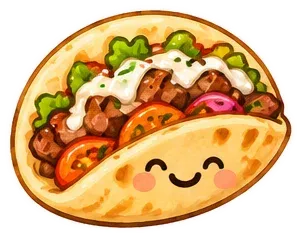
Kebab is slices of juicy meat from a big, turning spit, put in warm bread with salad and sauce. It comes from Turkey and the Middle East. It smells of spices and the grill. Often there is tomato, cucumber and onion inside. Try holding the kebab with both hands so the juice does not drip.
When a Norwegian child gets a kebab, it is usually one of three things. Kebab in pitta, with meat, salad and sauce stuffed into a pitta bread. A rolled kebab, wrapped tightly in thin flatbread. Or a kebab plate, with the meat beside chips, salad and a dollop of sauce.
For a first taste, the difference matters. Getting everything rolled up together is a very different thing from getting it laid out.
The word
In Turkish, kebab means grilled or roasted meat, and there are many kinds: chunks on skewers, mince pressed around a broad skewer, meat cooked in a pot. What Norwegians call kebab is nearly always doner kebab. Döner means turning. The meat is stacked or pressed onto a vertical spit that rotates in front of the heat, and the cook shaves thin slices off the outside, where it has gone brown and crisp.
It can be lamb, beef, chicken or a mix. Some places use slices of whole meat, others a seasoned mince pressed into a large cone.
The sauce
Many kebab shops in Norway ask if you want mild or hot sauce. The mild one is usually a white garlic sauce made with yoghurt or mayonnaise. The hot one has chilli. It is the sauce, not the meat, that can turn a kebab into a bad experience for a child.
Ask for mild, or for sauce on the side. Then your child can taste the meat first. It is salty and lightly spiced, with crisp brown edges. It can taste a bit like gyro or fried mince.
Start with the plate
For an unsure child, the kebab plate is often easiest. Chips are familiar. The meat sits on its own. The salad can be left in peace. Your child can begin with a chip, then a piece of meat, then perhaps a piece dipped in sauce.
Kebab in pitta comes next. The pitta is open at the top, so your child can see what is inside and pick things out. The rolled kebab is hardest, because it is closed and the sauce is rolled into everything.
The smell
Queueing at a kebab shop, the smell is strong. Frying meat, spices, garlic. Some children get hungry from it. Others decide the food is hot before they have tried it. Saying it out loud can help: the smell is strong, but the meat is not.
Relatives
Kebab belongs in the same family as shawarma and Greek gyros. All three are meat from a turning spit, with slightly different spices and sauces. The garlic sauce is related to tzatziki, which is made from yoghurt and cucumber. If your child has tried one of them, the others are a short step away.
The guide on when they say no has more on children who turn food down before tasting it.
One piece of meat
The meat with no sauce is plenty for a first go. It puts a star in the jar in Mumse, and the sauce can be a taste of its own another day.
 Gyro
 Kofta
 Chips
 Falafel
 Burrito