Burrito
A burrito is a present you can't see into. For some children that's exciting. For others it's exactly why it stays on the plate.
- Taste
- mild, salty, savoury
- Texture
- soft, creamy, juicy


Read aloud to your child
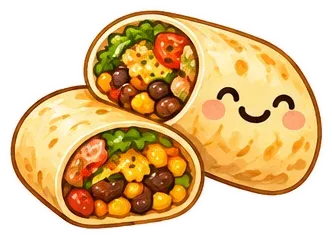
A burrito is a big, soft tortilla folded around a filling of rice, beans, meat and cheese. Everything hides inside like a present. It comes from Mexico and is eaten with your hands. Feel how warm and thick it is to hold. What do you think is inside?
Pick up a burrito and it’s heavier than you expect. A large flour tortilla is rolled tightly round a filling of rice, beans, meat, cheese and sauce, with both ends tucked in. Nothing shows. It might come wrapped in foil, and even with the foil peeled back, it still looks like a parcel.
A child who likes to know what they’re eating has good reason to pause here.
What’s inside?
The first thing to do is show it. Cut the burrito in half at an angle so the filling shows in the cut. Now it looks like a slice of layer cake, with stripes in different colours. White rice, brown beans, meat, yellow cheese and maybe green guacamole.
Ask your child what they can see. How many things? What do you think the brown is? They don’t have to taste anything to answer. Looking and guessing is a way of getting closer.
For many children the beans are the new part. They’re soft, slightly floury and have a thin skin. In a burrito they’re usually black or pinto beans, whole or mashed. If your child has tasted beans in chili con carne, it’s the same idea.
Build a little one
Burritos are easy to make at home from what’s left over after taco night. Nearly the same bowls, just with rice and beans added. Give your child a small tortilla, warmed so it’s soft, and let them choose the filling.
Roll it up and wrap it in foil or baking paper. The wrapping holds it together and makes it easier for small hands. Your child can peel the foil down bit by bit as they eat.
A small burrito with rice, cheese and meat, plus one spoonful of beans, is a good first step. Your child decides whether the beans go in.
From Mexico and California
The burrito comes from northern Mexico, where flour tortillas are more common than corn, and there it was often fairly slim, with just a little meat or beans inside. The big, fat burrito with rice, beans and everything else became popular in San Francisco and elsewhere in California in the 1960s and 70s. That’s the one that spread around the world, including to burrito bars in Nordic cities.
The name means little donkey. Why is anyone’s guess. Perhaps because it carries so much. Children tend to like that story.
When it doesn’t work
Some children dislike burritos because everything’s mixed. That’s understandable. Try a burrito bowl instead, with the fillings side by side in a bowl and the tortilla next to it. Same flavours, opened up. Your child can take one thing at a time and perhaps, at the end, roll some of it into the tortilla themselves.
A quesadilla with just cheese can be an easier route too. It’s flat and crisp, and you can see what’s in it.
Beans for the first time
A burrito with beans inside for the first time is a fine reason for a star in Mumse, whether the thumb points up or down. In Food World it sits under the Americas, with the quesadilla, fajitas and empanada.
 Tortilla
 Guacamole
 Arroz con pollo
 Quesadilla
 Soured cream