Danish pastry
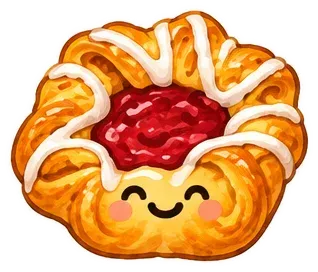
A crisp pastry of thin layers of dough and butter, with custard, jam or cinnamon in the middle. It shatters when you bite, and the filling changes from bakery to bakery.
- Taste
- sweet
- Texture
- crunchy, soft, creamy




Read aloud to your child
Danish pastry is a crisp, flaky treat made of many thin layers of dough and butter. Many have a filling of custard, jam or cinnamon. It crumbles when you bite, so the crumbs fly. Feel the thin, crisp layers melt in your mouth.
Nobody eats a Danish pastry neatly. The first bite sends flakes down your jumper, across the table and onto the floor. That is part of the experience, and for a child it can be half the fun.
Layer upon layer
Danish pastry is made from a dough with cold butter folded into it. The dough is rolled out and folded again, many times over, until there are hundreds of thin layers of dough and butter stacked on top of each other. In the oven, the water in the butter turns to steam and pushes the layers apart. That is why it flakes.
It is the same idea as a croissant. The difference is that Danish dough usually has a little sugar and egg in it, and there is almost always a filling.

A name from Vienna, by way of Copenhagen
The technique is said to have reached Denmark with Viennese bakers in the 1800s. Danes called the pastry wienerbrød, Vienna bread, and the name travelled on to Norway and Sweden. In Germany and Austria similar pastries are often called Kopenhagener or Danish pastry. Each city gives the credit to the other.
In Norwegian bakeries you often see long filled strips sliced into pieces, or single pastries shaped as pretzels, circles and swirls. A Danish strip is a regular sight at meetings and on cake tables.
Choose the filling
Fillings vary a lot, which makes this a good place to let your child choose. Custard is smooth and mild. Jam, often raspberry or strawberry, is sweet and slightly tart. Cinnamon and sugar is spiced. Remonce is butter and sugar creamed together, often with almond or marzipan, and it is sweet and rich.
Stand at the counter together and point. What colour is the filling in that one? Which do you think is sweetest? A child who chose is more curious about what they got.
At home, cut one or two pastries into pieces with different fillings and taste them one after the other. A little tasting test where nothing has to be right or wrong.
The texture takes some getting used to
For some children the dry, crisp flakes are the hard part. They shatter, stick to the roof of the mouth and feel nothing like ordinary bread. Underneath are soft, buttery layers, and in the middle a creamy filling. That is three or four different sensations in one bite.
It helps to break a piece open and show the layers. Hold it up to the light. Count them if you can. Peel off one layer and let your child feel how thin it is. Then the crisp bits are something they know about, not something that ambushes them.
Eat over a plate. The crumbs will escape anyway.
Close relatives
If your child likes the custard, the Norwegian custard bun is a close relative with soft dough. A cinnamon roll has the cinnamon without the flakes. And strawberries are what is often hiding in the jam.
However many crumbs end up on the floor, a bite is a taste, and in Mumse it earns a star.
 Custard bun
 Custard
 Cream bun
 Apple cake
 Almonds
 Bread with jam