Almonds
Lots of Norwegian children have hunted for an almond long before tasting one. It hides in the Christmas Eve rice pudding, and whoever finds it wins a marzipan pig.
- Taste
- mild, sweet
- Texture
- crunchy, dry




Read aloud to your child
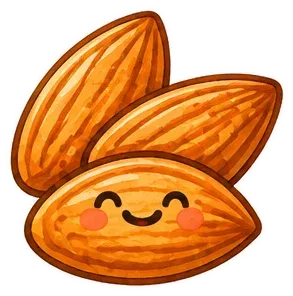
Almonds are flat, oval nuts with a brown skin and a white, firm inside. They grow on almond trees that bloom pink and white in spring, and are really seeds inside a fruit. The taste is mild and a little sweet, and they crunch loudly. Almonds are also used to make marzipan.
Hunting for the almond
On Christmas Eve in many Norwegian homes, a big bowl of creamy rice pudding sits on the table. Somewhere in it is one whole almond. Everyone eats slowly, feeling around with their tongue, and whoever finds it gets a marzipan pig.
That’s probably the most thrilling way a child can meet an almond. You search for it. You hope to feel it in your mouth. And when you find it, you hold it up for everyone to see.
It isn’t the same as tasting, but it’s a good start. The almond is already something you want.

Hard, dry and mild
A whole almond is hard and crunches loudly. It’s dry in the mouth and needs a lot of chewing, which is often what children dislike. The taste is mild and slightly sweet, with a brown skin that can taste a bit bitter.
There are lots of ways to make almonds easier:
- Skinless. White blanched almonds are milder and less dry.
- Toasted. Almonds toasted in a dry pan get crisper and tastier. The smell alone brings children over to look.
- Flaked. Thin flakes on yoghurt or porridge are easy to chew and not scary.
- Ground or as almond butter. Smooth and mild.
Whole almonds can get stuck in a young child’s throat, so flakes, ground or finely chopped almonds are safer for little ones; your health visitor can tell you when your child is ready.
Almonds that pop
Here is a kitchen job children love: pour boiling water over a bowl of almonds and leave them for a few minutes. Rinse in cold water. Then squeeze each almond between thumb and finger, and the white almond shoots out of its brown skin. Sometimes quite a long way.
Afterwards you have a bowl of smooth white almonds, and a child who has handled every single one.
Marzipan and kransekake
Marzipan is finely ground almonds mixed with sugar. Marzipan eggs at Easter, marzipan pigs at Christmas and the green lid on a princess cake are all made from almonds. So is kransekake, the tower of almond rings that appears at Norwegian birthdays, weddings and on the 17th of May. It’s made from almonds, icing sugar and egg white.
If your child likes marzipan or kransekake, they like almonds. Same flavour, sweeter and soft. Worth mentioning.
A fruit with a stone
Almond trees blossom pink and white in spring, in warm places like Spain and California. The almond is really the seed inside a fruit that looks like a small, green, fuzzy peach. Nobody eats the flesh. It’s the stone in the middle that gets cracked, and inside the stone is the almond.
So almonds are related to peaches, plums and cherries. Crack a peach stone one day and show your child that there’s something inside that looks like an almond. That one is for looking at, not eating.
One flake is enough
Almonds are dry, and it’s fine not to like that. Offer a single flake instead of a whole almond, and leave it there.
The almond in the rice pudding comes back every year. So do the rest of the almonds.
One almond flake is a taste. In Mumse it fills a star space on the shelf, and after five days almonds are gold food.
 Hazelnut
 Marzipan egg
 Pistachios
 Rice porridge
 Cashew nuts
 Rice pudding




