Cinnamon
Cinnamon is one of the few spices children recognise by smell alone. It smells of buns, porridge and December. That it's actually bark from a tree is news to many children.
- Taste
- sweet, spicy
- Texture
- dry





Read aloud to your child
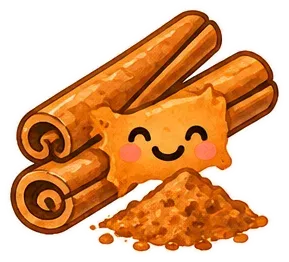
Cinnamon is brown bark from a tree that grows in warm countries, and it is rolled into sticks or ground into powder. It smells sweet and warm, like cinnamon buns and Christmas baking. The taste is sweet and a little spicy and warms your mouth. Feel a cinnamon stick, it looks like a tiny rolled-up scroll.
A rolled-up letter
Give your child a cinnamon stick and ask them to look inside. It’s hollow and rolled up in layers, like a tiny scroll or a rolled-up letter. It’s hard, brown and smells strong. And it’s bark.
Cinnamon is the inner bark of a tree that grows in warm countries. The bark is cut away, dries and curls up by itself. It’s one of the strangest foods in the kitchen, and one of the most familiar.

The smell comes first
With cinnamon you don’t need to start by tasting. The smell is so distinct it’s almost a taste in itself. Open the jar and let your child sniff. Ask what it makes them think of. Lots of children say buns, porridge or Christmas before they know what the jar is called.
A cinnamon stick smells less than the ground stuff, but more when you snap it. Break one together and sniff the broken end.
Ground cinnamon shouldn’t go straight into the mouth off a spoon. It’s dry and dusty, and the powder can get into the throat and cause a fierce cough. Taste it sprinkled on something instead.
Porridge with a butter eye
In Norway, rice porridge with a knob of butter, sugar and cinnamon is a Saturday classic and Christmas food. For many children, that’s where cinnamon belongs. Brown on white, and sweet because it arrives with sugar.
There’s cinnamon in cinnamon rolls, in gingerbread biscuits and in apple cake too. Children who like these like cinnamon. But they’ve rarely met cinnamon on its own.
Cinnamon without sugar
Cinnamon tastes sweet even without sugar. It has a warm, slightly hot flavour you feel on the tongue. That’s worth discovering:
- On apple. Apple slices with a sprinkle of cinnamon. Nothing else.
- In porridge. A pinch in the porridge while it cooks. The smell rises from the pan.
- On yoghurt. A dusting over plain yoghurt. The cinnamon makes it taste less sour.
- Warm milk with a stick. Leave a cinnamon stick in the milk while it warms. Fish it out and let your child notice that the milk tastes of cinnamon.
Not only sweet
Cinnamon isn’t just sweet. It has a warmth that can surprise, especially in larger amounts. Too much can sting the mouth and turn bitter. Start small.
In many parts of the world cinnamon goes into savoury food: meat stews, rice and spice blends. A good reminder that cinnamon is a spice, not a sweet.
Two trees
Two kinds of cinnamon are common in shops. Ceylon cinnamon comes from Sri Lanka, has thin, brittle layers and is mild. Cassia has thick, hard bark and a stronger taste, and a lot of shop cinnamon is cassia. Cassia contains a lot of a substance called coumarin, and small children shouldn’t have much of it every day. A pinch now and then is plenty. If you have both, lay the sticks side by side. One looks like a paper cigar, the other like a thick tube.
When it’s too much
Some children find cinnamon too strong. That’s fine. Let it be a smell for a few weeks. The smell turns up anyway whenever buns are baked.
A sprinkle of cinnamon on an apple slice is a taste. In Food World in Mumse there is a short passage about the bark that curls itself up, and a sprinkle earns a star like everything else.
 Cinnamon roll
 Rice porridge
 Apple cake
 Gingerbread biscuit
 Ginger
 Rice pudding