Christmas brittle
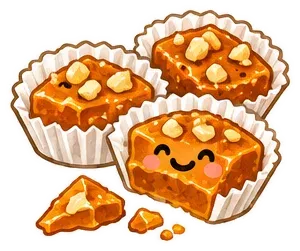
Hard brown toffee with nuts or almonds, boiled from sugar, syrup and cream. Norwegians call it knekk, which fits the snap it makes, and it belongs to Christmas.
- Taste
- sweet, bitter
- Texture
- crunchy, chewy




Read aloud to your child
Knekk is hard, brown Christmas toffee made of sugar, cream and nuts. It is boiled and poured on a tray, and then broken into pieces. Listen to how loudly it snaps, and let it melt slowly.
The name fits the sound. A big slab on a tray, broken into shards with a sharp crack, or small rounds set in paper cases. In many Norwegian homes it is as much a part of Christmas as marzipan and gingerbread.
Sugar boiled for a long time
Knekk is sugar, syrup, cream and butter boiled until thick and brown. Nuts or almonds go in at the end. The mixture is poured into little paper cases or onto a tray, and once it cools it is hard as glass. Think of a British nut brittle crossed with butter toffee.
The taste is sweet, but not only sweet. Sugar that has boiled for a long time develops a deep, slightly bitter caramel flavour. The nuts add another taste and another crunch. There is a lot going on in a small piece.
First hard, then chewy
Knekk changes in the mouth. The first bite is hard and crunchy. Then the warmth starts to soften it, and it turns chewy and tacky. Finally it clings to the teeth and takes a long time to work loose.
For many children that last part is the problem. Not the taste, but the feeling of something stuck. Sucking a small piece and letting it melt slowly is easier than chewing a big one.
Safety first
Hard toffee and bits of nut can get stuck in a small child’s throat, so knekk is best kept for children old enough to manage hard foods. Your health visitor can tell you more about what suits your child’s age.
Make it together, from a distance
Knekk is exciting to make, but the toffee gets extremely hot, far hotter than boiling water. Your child can still help. They can measure the sugar and set out the paper cases. They can watch the toffee change from pale to brown in the pan and notice the smell changing too.
Once it has cooled, your child gets to do the breaking. Listen. The snap is almost the best part.
Caramel in many forms
It is fun to show a child that caramel can be many things. Hard and crunchy in knekk. Runny and glossy over crème caramel. Chewy in toffees. Same sugar, just boiled to different temperatures.
That makes knekk a nice part of a tasting game in December. Put out small pieces of different Christmas sweets and taste them one after another. Which is hardest? Which is sweetest? Which sticks the most? There are more games like this in tasting games.
The nuts
The nuts in knekk are often almonds, peanuts or hazelnuts. A child who wants to know what is inside can taste them separately. Almonds and peanuts have their own pages. And a marzipan egg is another sweet made from almonds, soft instead of hard.
One small piece left to melt is a taste. Knekk is among the sweets in Mumse.
 Gingerbread biscuit
 Almonds
 Chocolate
 Marzipan egg
 Hazelnut




