Pear
Pears have a gentle sweetness most children ought to enjoy. What stops many of them is the feel: slightly gritty, slightly juicy, and sometimes soft and mealy.
- Taste
- sweet, mild
- Texture
- juicy, grainy, soft



Read aloud to your child
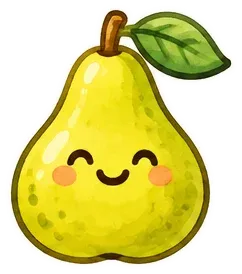
A pear is shaped like a little bell, slim at the top and round at the bottom. It grows on trees and ripens in late summer and autumn. The skin can be green or yellow, and the flesh is soft, juicy and sweet. Some are a little grainy. Hold it in your hand and feel how round and heavy it is.
Moody fruit
An apple is easy to understand. It crunches, and the last bite feels like the first. A pear is moodier. The same pear can be hard on Monday, just right on Tuesday and brown and mealy by Thursday. For a child who likes food to behave predictably, that is no small thing.

The grains of sand
Bite into a pear and pay attention. Between the juicy parts there is something like fine sand. These are stone cells, small hard cells in the flesh. They are completely harmless, but they are the reason many children call pears “weird”. They are thickest around the core and just under the skin.
It helps to know that varieties differ a lot. Some pears are almost smooth and melt in the mouth. Others are firmer and grittier. A child who has turned down one pear has not necessarily turned down all of them.
Ripeness is everything
Pears are picked before they are ripe and finish ripening at home. They also ripen from the inside out. Wait until a pear feels soft all over and it may already be brown and mushy around the core.
So check the neck instead. Press gently with a thumb where the pear is narrowest. If it gives slightly, it is ready. This makes a good job for a child: checking the pears every morning and announcing when they are done. By the time the pear is tasted, they have handled it for days.
Ways to start
- Thin peeled slices. Thin is easier than thick. The grit is less noticeable, and the juice is still there.
- A cold pear. Straight from the fridge it is firmer and fresher.
- Pear next to apple. Cut one slice of each and let your child compare. Which crunches more? Which is sweeter?
- Warm pear. Baked or in a cake, pear turns soft and sweet and the grit almost disappears. There is a page on apple cake that works the same way.
Cut pear turns brown quickly, just as apple does. It tastes the same, but a child who finds brown off-putting will be happier with fresh slices.
That shape
No other fruit is shaped like a pear. Narrow at the top, round at the bottom, a bit like a light bulb or a drop of water. A pear is easy to draw and easy to recognise. Let your child hold one and feel how heavy the bottom is. Perhaps it can stand up on the table by itself.
Pears from the fjords
In autumn, Norwegian pears appear in the shops. Many of them are grown in western Norway, mainly along the Sogn and Hardanger fjords. The season is short and some of the fruit is small and uneven. That can be a reason to buy a few, take them home and let your child decide which one gets tasted first.
When your child says it is horrible
Ask what is horrible about it. If the answer is “it’s mushy”, it was probably too ripe. If it is “it’s sandy”, try a different variety or a warm pear. Both are useful answers, and neither means pears are off the menu for good.
If pear is on the shelf in Mumse, your child can tap it on any day they have tasted a slice. After five different days it shines as gold food, hard or soft, liked or not.
 Apple
 Mango
 Fruit salad
 Green grapes
 Apple cake
 Walnut