Fajitas
At a restaurant, fajitas arrive on an iron plate that sizzles and smokes. At home it's strips in a frying pan. Either way it's easy to split up for a child.
- Taste
- salty, mild, sweet
- Texture
- juicy, soft




Read aloud to your child
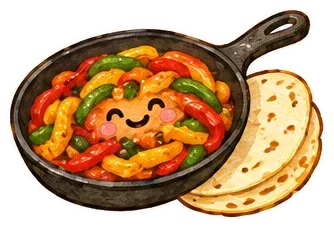
Fajitas are strips of chicken or beef and colourful strips of pepper cooked together, and come from Tex-Mex cooking. Everything is served with soft tortillas that you fill and roll yourself. The sizzling, steaming pan smells fantastic. You decide what goes into your tortilla.
The sound arrives before the food. At a Tex-Mex restaurant fajitas are carried out on a hot iron plate, the meat and vegetables hissing and spitting as they hit the table. There’s steam. It smells of the grill and onions. Next to it come a basket of warm tortillas and little bowls of sour cream, cheese, salsa and guacamole.
For a child that can be a bit much. But it’s also a show. And a show is a good start.
Strips, not mince
Fajitas are strips of chicken or beef, cooked fast over high heat with strips of different coloured peppers and onion. The seasoning is usually cumin, paprika, garlic and lime. Everything turns juicy and a bit brown at the edges, and the peppers go sweet and soft.
The difference from Norwegian Friday tacos is that everything is in strips. That makes it easier to see what’s what. A strip of chicken is clearly chicken. A strip of red pepper is clearly pepper. Nothing is chopped up or mixed into a sauce.
That helps children who want to keep track of their plate.

Pick with your fingers
Put the strips on a plate and let your child pick. Chicken first, perhaps. It’s mild and familiar, much like sliced chicken breast. Then a strip of pepper.
Red pepper is the sweetest. Green is more bitter. Yellow and orange are in between. Put one of each colour in front of your child and let them taste in whatever order they like. Is there a difference? Plenty of adults don’t know they taste different, and your child might be the one who finds out.
The onion often gets left. Let it be. Cooked onion is sweet and soft, but it’s slippery and stringy, and that texture is hard for many children.
Roll your own
The best thing about fajitas for children is that everyone rolls their own. Your child takes a warm tortilla, adds what they want and rolls. Nobody else has decided what goes inside.
It might be very little. A tortilla with two strips of chicken and some cheese. That’s a fajita. Next time there might be a strip of pepper. The step is small, and your child takes it themselves.
From Texas
Fajitas come from Texas, along the Mexican border. Ranch hands were given the cheap cuts, including the tough skirt from the diaphragm of the cow. They grilled it over an open fire, sliced it thinly across the grain and ate it in tortillas. Faja means belt or strip in Spanish. The dish caught on in Texas restaurants in the 1970s and 80s, and the sizzling iron plate came with it.
At home
At home there’s rarely a sizzling plate, but an ordinary frying pan works. Cook the chicken first, lift it out, then cook the vegetables. That way they go on the plate separately and your child sees what’s what. Season the grown-ups’ share and leave your child’s with just salt and a little lime.
Fajitas can easily stand in for tacos on a Friday. Same bowls, same tortillas. Only the meat changes.
One strip
One strip of green pepper is a small, brave bite. In Mumse it earns just as much of a star as a whole fajita.
 Red pepper
 Tortilla
 Fish taco
 Guacamole
 Chicken thigh
 Enchiladas




