Crackers
Thin, dry crackers that snap when you bite them. On their own they taste of almost nothing, and that is exactly what makes them useful.
- Taste
- mild, salty
- Texture
- crunchy, dry



Read aloud to your child
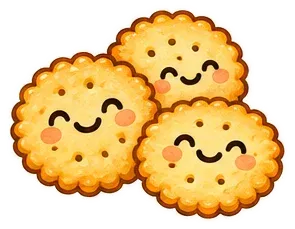
Crackers are dry, thin biscuits baked until they are crisp. They can be round or square, and they often have tiny holes in them. Crackers taste mild and a little salty, and they snap when you bite them. Many people eat them with cheese or just on their own. How many crumbs can you make on your plate?
A cracker is the opposite of a surprise. It is flat, pale, dry and tastes of little more than flour and a pinch of salt. Children who are wary of most things will often say yes to a cracker. That makes it a good plate.
Holes and crumbs
Look at a cracker with your child before you eat. The little holes were pricked into the dough before it was baked, so the steam could get out. Without them the cracker would puff up in bubbles. Some children like counting the holes. Others want to look through them.
Then there are the crumbs. A cracker snaps into flakes, and the flakes turn into crumbs that end up everywhere. They are dry and can tickle the throat, and for some children the dryness is the hard part. A glass of water or milk alongside makes it easier.
One word, two things
In Norwegian, kjeks covers a lot: sweet biscuits for coffee, oat biscuits, animal-shaped biscuits for children, and the flat savoury crackers people eat with cheese. This page is about the last kind. They taste mild, they are crisp all the way through, and they have nothing that competes with whatever goes on top.
A tasting board
Put four crackers on a plate and give each one something different on top. A slice of cheese, a little cream cheese, a dab of mackerel in tomato sauce, and one with something your child has never tried. Perhaps a thin slice of cucumber, a piece of ham or a teaspoon of jam.
Four choices feel different from a single plate. Your child can start with the familiar and end with the new, or just look at the new one. The cracker underneath stays the same the whole time, holding everything together.
Small portions help. A cracker is small enough that the new topping never amounts to much. Half of half a teaspoon is enough to taste.
The mackerel
Mackerel in tomato sauce is a classic Norwegian topping that comes in a tin, and many children are deeply suspicious of it. It is red, wet and smells of fish. On a cracker it becomes small and tidy, and it does not soak in the way it does on a slice of bread with mackerel in tomato sauce. A child who will not have mackerel on bread may well taste it on a cracker. It is not entirely logical, but it happens.
From cracker to bread
Once a cracker with a topping is familiar, the next step is often a different base. Crispbread is just as crunchy, but coarser and tastes more of grain. After that, the same topping can go on an ordinary slice of bread. It takes time, and many tries with the same thing. There is more on that in the guide to how many times children need to taste.
Every topping on the tasting board is a food of its own in Mumse, with its own star for the child who tried.
 Pretzel sticks
 Granola bar
 Gingerbread biscuit
 Tea
 Cheese