Rice cakes
Round, airy cakes of rice puffed up by heat and pressure. They crunch, they crumble, and they taste so little that almost anything can go on top.
- Taste
- mild, salty
- Texture
- crunchy, dry




Read aloud to your child
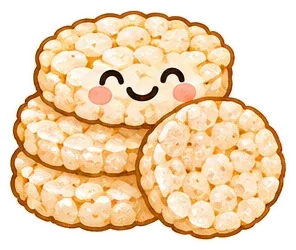
Rice cakes are round, flat cakes made from rice that has been puffed up with heat and pressure. They are light as air and crunch when you bite them. They taste mild, a bit like rice and a little salty, and they go nicely with cheese, butter or a little jam. Feel how the tiny grains stick together.
People like to say rice cakes taste of cardboard. They are not entirely wrong. A plain rice cake tastes of a little rice, a little salt and not much else. But for a child who is about to try something new, that blandness is useful.
Rice under pressure
Rice cakes are made by putting rice grains into a hot mould and pressing them under high pressure. When the pressure is released, the grains puff up and stick to one another. The result is a flat round disc that is mostly air. It is more or less the popcorn trick, only with rice and a mould.
Look closely and you can see the separate grains, packed tight like a mosaic of tiny white pillows. Children enjoy seeing that, and they enjoy it even more if you put an ordinary grain of rice next to it and compare how much it has grown.

The squeak and the crumbs
Rice cakes crunch loudly, with a squeaky sound a bit like polystyrene. Some children think that is funny, others find the noise and feel odd. They are dry and soak up saliva, so they turn slightly gluey against the roof of the mouth after a few bites. And they crumble. Everywhere.
For a lot of children, rice cakes are a familiar food. That is exactly what makes them handy.
A safe base
When your child tries a new topping, what it sits on matters. Bread has its own taste and texture, and some children are not sure about bread to begin with. A rice cake is neutral. The new flavour gets to stand on its own, and the cake is just something to hold.
Try a thin line of something new on half a rice cake. Liver pâté, mackerel in tomato, Norwegian brown cheese, hummus. Your child can bite the bare edge first and work towards the middle. Nobody needs to comment.
It works the other way round too. A child who likes rice cakes with butter can try a different rice cake: dark chocolate, yoghurt coating, sesame, or one made from corn instead of rice. A small change to something familiar is often easier than something entirely new.
For the youngest, a rice cake works best as an occasional taste rather than an everyday base. The Norwegian Food Safety Authority advises against rice cakes for small children because rice can contain arsenic, so ask your health visitor if you are unsure.
Small steps still count
It is tempting to think a rice cake with a smear of something new is not a proper try. It is. Each time your child meets a flavour, it becomes a little more familiar, even when it is just a line. The number of meetings is what matters, and there is more on that in how many times.
Neighbours
Crispbread is the Norwegian cousin: crunchy, dry and neutral, but coarser. Popcorn is made in almost the same way. And once rice cakes feel easy, bread with brown cheese might be the next step towards ordinary bread.
A new topping on a familiar rice cake earns a star in Mumse too. The topping is the brave part.
 Cheese puffs
 Popcorn
 Bread with peanut butter
 Bread with prim
 Cream cheese
 Pretzel sticks