Couscous
Couscous is tiny pellets of wheat, small enough to count on a spoon. Children may know it as a quick side dish. In North Africa it is the centre of the meal.
- Taste
- mild, salty, spicy
- Texture
- grainy, soft, juicy




Read aloud to your child
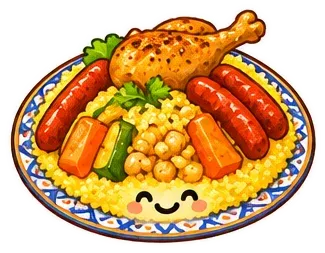
Couscous royal is the party version of couscous from North Africa. Couscous is tiny balls of wheat steamed until light and fluffy. It is eaten with a spiced vegetable stew of carrot, courgette and chickpeas, and several kinds of meat: chicken, lamb and spicy merguez sausages. The broth from the stew is poured over so the couscous turns juicy. Scoop up the little balls and feel how they roll.
Pour a spoonful of couscous onto a plate and the grains roll. They are tiny, separate and light, and you can almost count them. Many children meet couscous as a side dish from a packet: pour on boiling water, cover, wait five minutes, fluff with a fork. That is couscous at its plainest, and it is a good place to start.
Where it comes from
Couscous comes from North Africa, from Morocco, Algeria, Tunisia and the countries around them. In 2020 the knowledge and traditions around it were added to UNESCO’s list of intangible cultural heritage. It is not a grain but tiny balls of durum wheat semolina, rolled with water by hand or machine. That makes it a close relative of pasta.
In North Africa it is traditionally steamed in a two-tier pot. The couscous sits on top, while meat and vegetables simmer below, and the steam makes the grains fluffy and carries flavour into them. The stew and its broth are served on top.
Couscous royal
The version French restaurants made famous is couscous royal. It is couscous with a vegetable stew of carrot, courgette, turnip and chickpeas, plus several meats at once: usually lamb, chicken and merguez, a thin, spiced sausage. That multi-meat plate became popular in France. In North Africa a couscous more often has one kind of meat or fish.
For a child, couscous royal is a lot at once. That is fine. It comes in parts, and the parts can be tasted one at a time.
The grains alone
Plain couscous tastes of very little. It is mild, slightly nutty, and sits somewhere between rice and porridge in the mouth. Some children love the feeling of the little balls rolling around. Others find it odd.
Give your child a spoonful without broth. How does it feel? Is it like rice? They can touch it, stir it and watch it fall off the spoon. That helps, because couscous behaves differently from most foods on the plate.
The stew
The vegetable stew is seasoned with cumin, coriander and cinnamon, among others, and sometimes with harissa, a hot chilli paste. The carrots and chickpeas are soft. The broth is yellow or reddish.
Many children feel safer with the vegetables kept apart. Pick a carrot out of the stew and put it on the plate. It is familiar, only cooked in something new. Does it taste of carrot, or something else? The chickpeas can wait for another day.
The meat
The three meats are quite different. Chicken is mild and soft. Lamb has a stronger flavour and often falls apart. Merguez is red with paprika, spiced, and can be fairly hot. Taste it before your child does.
Merguez is thin and round. Pieces of sausage can get stuck in a small child’s throat, so cut it lengthwise, and ask your health visitor if you are unsure. If sausage is a favourite, merguez is still a natural bridge, just with more spice.
Not all at once
A spoon of grains, a carrot and a bit of chicken is plenty for a first go. Maybe only the grains. Next time the broth can go over. It usually takes several goes, and how many times explains why.
Five tastes on five different days turn a food into gold food in Mumse. The first can be a spoonful of tiny grains. The stew can wait.
 Chicken stew
 Peanut stew
 Kofta
 Paella
 Rice