Peanut stew
If your child likes peanut butter, this stew isn't far away. It's called mafé in Senegal and Mali and domoda in the Gambia, and it's savoury, not sweet.
- Taste
- salty, sweet, savoury
- Texture
- creamy, soft





Read aloud to your child
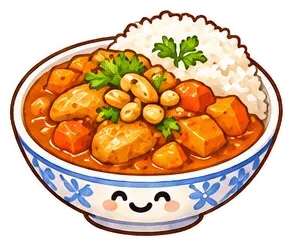
Peanut stew is a famous stew from West Africa, where it is called mafé or domoda. The peanuts are ground into a thick, shiny, orange-brown sauce that tastes a bit like peanut butter, but salty and warm. Chicken pieces and sweet potato simmer in the sauce, and whole peanuts and coriander lie on top. White rice on the side soaks up the sauce.
Close your eyes and smell the pot, and you’ll know straight away: peanut. The sauce is thick, glossy and orange-brown, and it smells like warm toast with peanut butter. But it doesn’t taste sweet. It tastes salty and rich, with a bit of tomato and onion.
That can surprise a child. Peanut butter goes on bread. Here it’s dinner.
What it is
Peanut stew is common across much of West Africa. In Senegal and Mali it’s called mafé, in the Gambia domoda, and in Ghana there’s a thinner soup called groundnut soup. Every family makes its own. The base is peanuts roasted and ground into a thick paste, or simply peanut butter. It’s stirred together with tomato, onion, garlic and stock, then simmered with meat, often chicken, lamb or beef, and vegetables like sweet potato, carrot or cabbage.
It’s nearly always served with white rice, which soaks up the sauce.
Peanuts actually come from South America. Portuguese ships carried them to West Africa in the 1500s, and they’ve been an important part of cooking there ever since.

Peanut stew in Norway
Peanut stew has become an everyday dish in many Norwegian homes. It’s easy to make and tastes familiar. So quite a few Nordic children have met some version of it, often a mild one with chicken and sweet potato.
It’s a good way into West African food. And a good story for the table: this stew is made in Senegal, and the peanuts in it once sailed from America to Africa.
The sauce and the rice
Start with the familiar. A spoonful of rice with a little sauce at the edge. Ask your child what it tastes of. Do they recognise the peanut butter?
Once the sauce is familiar, the chicken can follow. It’s soft and has soaked up the peanut flavour. Sweet potato is sweet and soft, almost like mashed carrot. Cabbage or other greens can wait.
If your child loves peanut butter, it can be fun to give them a tiny spoonful straight from the jar next to the stew. Taste one, then the other. What’s the difference? Your child works out that it’s salt, tomato and spice, which is a fairly advanced bit of tasting for a five-year-old.
The peanuts on top
Many people scatter chopped or whole peanuts and fresh coriander on top. They add crunch and colour. Whole nuts can be a choking risk for small children; leave them off or crush them very finely, and ask your health visitor if you’re unsure. Coriander is a taste many children dislike, so keep it in its own bowl.
Make it mild
Many recipes include chilli, and in West Africa that’s often scotch bonnet, a small and very hot pepper. At home you can leave it out entirely. Put chilli flakes or hot sauce on the table for the grown-ups. Children taste best when nothing stings.
The stew is better the next day and freezes well. That gives plenty of chances to taste, and each day is a new opportunity.
The next stew
Children who like chicken tikka masala often like peanut stew too. Both are creamy, mild stews with rice. In Food World in Mumse they sit on different shelves, one under Asia and one under Africa and the Middle East.
 Chicken stew
 Peanuts
 Chicken tikka masala
 Bread with peanut butter
 Couscous
 Lentil soup