Bread roll
A bread roll is a whole loaf that fits in a child's hand. It has a crust and a soft middle, a top and a bottom, and it can be pulled apart with fingers.
- Taste
- mild
- Texture
- crunchy, soft



Read aloud to your child
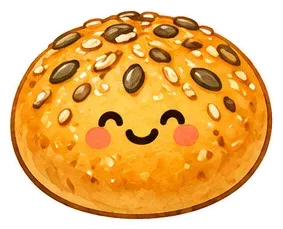
A bread roll is a small, round loaf that fits perfectly in your hand. It is crisp and golden on the outside and soft and airy on the inside. When you break it in two, you can hear a little crunch. The roll tastes mild and is lovely with cheese or jam.
In Norway they are called rundstykker, literally round pieces, and they are often a weekend breakfast: warm from the oven or the freezer, split, buttered and eaten with whatever is in the fridge. A roll is small enough for a child to hold in one hand and eat without a plate. It is a loaf they can own.
Pull it apart
Rolls get split. With a knife, the way adults do it, or with fingers. A child who tears a roll in half hears the crust crack and watches the soft inside stretch before it lets go. There is a lot to notice before the first bite.
Once it is split, there are two halves. That means two toppings. Something familiar on one, something new on the other. Or the same topping on both, but butter on only one, so they can feel the difference.

Crust and crumb
Lots of children eat the soft middle and leave the crust. That is no surprise. The middle is soft and mild. The crust is harder, darker and tastes of more, because it sat closest to the heat in the oven.
A fresh roll has a thin, crisp crust that crunches. Yesterday’s roll has a chewy one that has to be torn with the teeth. Those are two quite different things to ask of a child. If the crust is the problem, try a fresh roll, or warm an old one for a few minutes to crisp it up again.
The seeds on top
Many rolls have seeds on top. Sesame seeds are small and pale and taste faintly nutty once toasted. Poppy seeds are tiny and blue-grey. Sunflower seeds are bigger and soft. Some rolls have oats.
The seeds can become a game. Put three rolls with different toppings side by side. Your child picks a few seeds off each and tastes them alone before tasting the roll. Which were easiest to recognise?
A sprinkling of seeds on a roll is very different from a bowl of them, and for many children the top of a roll is where they first taste sesame or poppy.
Shape your own
Rolls are about the easiest bread to bake with a child. The dough is the same as for a loaf, but it is cut into small pieces and rolled into balls. That is your child’s job. The balls are rarely the same size, which doesn’t matter at all.
Then they can brush them with egg or milk and scatter seeds on top. While they rise, you can watch them grow. When they come out of the oven, the whole kitchen smells of bread.
A child who shaped their own roll recognises it on the tray. And they taste it with a different kind of interest than a shop-bought one.
White or wholemeal
Rolls come white, made mostly with wheat flour, and wholemeal, with coarse flour and grains. The white kind is close to white bread in taste. The darker kind is close to wholemeal bread.
For a child who struggles with wholemeal, a wholemeal roll can be a halfway house. It is smaller and fresher, and the crust is crisp. Try half a white and half a wholemeal on the same plate.
Warm from the oven
When rolls come to the table warm, butter melts into the crumb and cheese goes a little soft. It is a good moment to try a new topping, when everything else on the table is familiar and safe.
There is more in how to get children to try new foods.
Bread roll is among the bread and baking in Mumse. Your child earns a star for tasting it, even if it was only the soft middle. About Mumse.
 White bread
 Sunflower seeds
 Sesame seeds
 Bread with brown cheese
 Cream cheese
 Butter