Ice cream
Cold, soft and creamy, in scoops, on a stick or in a cone. Most people assume children say yes to ice cream. Many do, but not all, and there is usually a good reason.
- Taste
- sweet, mild
- Texture
- creamy, smooth



Read aloud to your child
Ice cream is a cold, soft, creamy treat that often comes in scoops. It is made from milk, cream and sugar that are frozen while being stirred, and it can taste of vanilla, strawberry or chocolate, for example. It melts on your tongue and can drip down your hand. Lick quickly, and feel how cold it is against your mouth.
Few things puzzle a grown-up quite like a child who says no thanks to ice cream. It feels a bit like turning down childhood itself. But ice cream is quite a demanding food, when you think about it.
Cold
Ice cream is cold, much colder than most other things a child puts in their mouth. It can hurt the teeth, and a big spoonful against the roof of the mouth can bring on a stabbing pain in the forehead that lasts a few seconds. A child who has felt that once may be careful for a long time.
It helps to let the ice cream stand for a bit, so it is softer and less cold. A small spoonful is easier than a scoop on a cone. Some children prefer licking to biting, because a lick takes less cold at a time.

It drips
Ice cream in a cone or on a stick does not wait. It melts as you eat and runs down your fingers. For a child who dislikes being sticky, that is stressful. They have to eat quickly, and if they do not, there is a mess.
A bowl and a spoon solve that completely. Your child can eat at their own pace, and the bit that melts at the bottom is just a cold, sweet sauce.
What hides inside
Vanilla ice cream is smooth all the way through. Many other kinds have things in them: chocolate chips, nuts, biscuit pieces, ripples of caramel, berries. For a child who is sensitive to texture, a hard lump in something smooth can be a surprise that spoils the whole thing.
If your child wants ice cream, but only the smooth kind, that is fine. It is a clear opinion about texture, and it tells you something useful about other food too.
New flavours in a familiar form
For a child who likes ice cream, it can become a bridge. The form is familiar: cold, creamy, sweet. The flavour can change. Strawberry ice cream tastes of strawberries, and a whole strawberry next to it shows where the flavour comes from. Pistachio ice cream is green and tastes of pistachios, which many children have never tried any other way. There is ice cream that tastes of mango, coconut, cinnamon and, in Norway, liquorice.
Frozen yoghurt is nearly ice cream, but tangier. You can freeze yoghurt in small moulds at home. And an ice lolly is ice without the milk, harder and sharper.
A small spoonful of a new flavour is enough. If it is not nice, it still took courage.
Not a prize
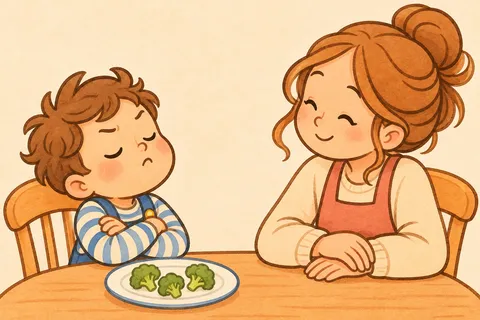
Ice cream is often something you are given. At the beach, after dinner, at birthdays. That is lovely. When ice cream becomes the thing you get for eating something else, it can change how a child sees both. The broccoli easily becomes something to get through, and the ice cream becomes what matters. The guide to when they say no covers the same ground.
In Mumse the rewards are never food or sweets. Ice cream sits on the shelf like any other food, and a spoonful of a new flavour earns a star.
 Ice lolly
 Fruit salad
 Crème caramel
 Smoothie
 Apple cake
 Yoghurt